 Motomaxsfr


Search Product
2 Piston VS 4 Piston Caliper: Analysis And Selection Guide
I am a technician with over ten years of experience in the motorcycle repair and modification industry. Today, I’m going to talk to you about this question that’s been asked to death: “Which is better, a 2-piston brake caliper or a 4-piston brake caliper?” To put it simply, there’s no absolute good or bad, only whether it suits your riding needs and vehicle configuration. Many beginners only focus on the number of pistons, which is a big mistake. Based on my experience, I’ll analyze the essential differences between these two braking systems and offer selection advice.
Overview
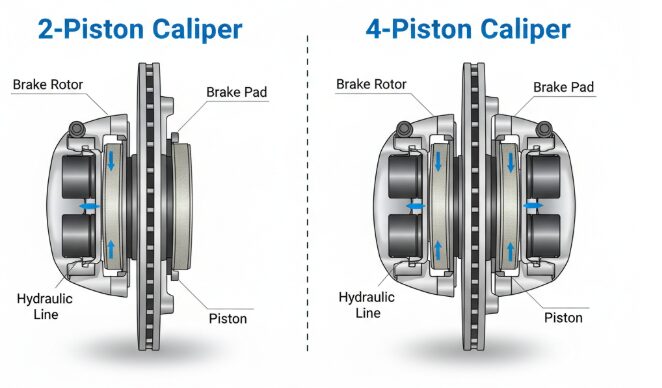
Pistons are the actuators in the braking system. Their function is very simple: to convert the hydraulic pressure generated by the master cylinder into mechanical force, pushing the friction pads (brake discs) to clamp the brake disc, thus generating braking force.
The number, diameter, and material of the pistons directly determine how much force and how evenly it can push the friction pads. This is the basis for our discussion of 2 pot and 4 pot caliper.
The Impact of Piston Number on Braking Performance
Braking Force and Efficiency
From a physics perspective, increasing the number of pistons generally means increasing the total cross-sectional area of the pistons. With the same hydraulic pressure output from the master cylinder, a larger total cross-sectional area results in a greater clamping force from the caliper.
- 4-piston: Its advantage lies in generally stronger initial engagement force and higher braking efficiency. During high-intensity or high-speed braking, it can quickly provide powerful deceleration, giving the rider great confidence and a safety margin.
- 2-piston: Although the total cross-sectional area may be smaller than that of a 4-piston caliper, its compact structure, if properly designed, still provides sufficient performance for low- and medium-speed braking. Its efficiency ratio (the ratio of structural complexity to braking force) is very high for small motorcycles.
Friction Plate Wear and Thermal Management
This is another important difference brought about by the number of pistons.
- 4-piston: Usually paired with larger, longer, or wider friction plates. This means that braking force is distributed over a larger area. In my experience, the more even distribution of torque results in more even wear of the friction plates. More importantly, there’s thermal management—the larger friction area and caliper body dissipate heat better. When driving on mountain roads or occasionally on the track, 4-piston calipers perform significantly better than 2-piston calipers in resisting brake fade, a natural structural advantage.
- 2-piston: The friction pads are usually smaller, resulting in concentrated force. Under prolonged and intensive use, heat accumulates quickly, easily leading to thermal decay and even excessive wear in some areas. Of course, they are perfectly fine for low-intensity use like city commuting.
Braking Feel and Linearity
This is a subjective but crucial aspect, affecting control precision.
- 4-piston: Generally offers a more linear and controllable braking feel. In other words, the increase in braking force is almost synchronous and smooth with the stroke of the handle you squeeze. This makes it easier for you to make precise braking control, especially under extreme conditions.
- 2-piston: In some designs, the braking force may come off a little abruptly, and the linearity is not as good as that of a high-quality 4-piston caliper. Of course, this largely depends on the master cylinder matching and the friction pad material.
Usage Scenarios and Selection Recommendations for Different Piston Counts
Applicable Scenarios for 2-piston Bikes
- Bike Types: City scooters, lightweight street bikes (300cc or less), light cruisers.
- Needs: City commuting, daily driving, occasional suburban riding.
- Advantages: Simple structure, low cost, easy maintenance. No need to pursue extra braking power; more than sufficient for daily use.
Applicable Scenarios for 4-piston Bikes
- Bike Types: High-performance street bikes, supersport bikes, heavy-duty rally bikes, and all models exceeding 200kg.
- Needs: Pursuing ultimate braking performance, frequent high-speed riding, mountain biking, track days.
- Recommendation: If your average riding speed is high, or your vehicle has high horsepower, a 4-piston caliper is a safe and redundant investment, absolutely worthwhile.
Common Brake Upgrade Misconceptions
The biggest misconception is “only focusing on the calipers.” This is absolutely unprofessional!
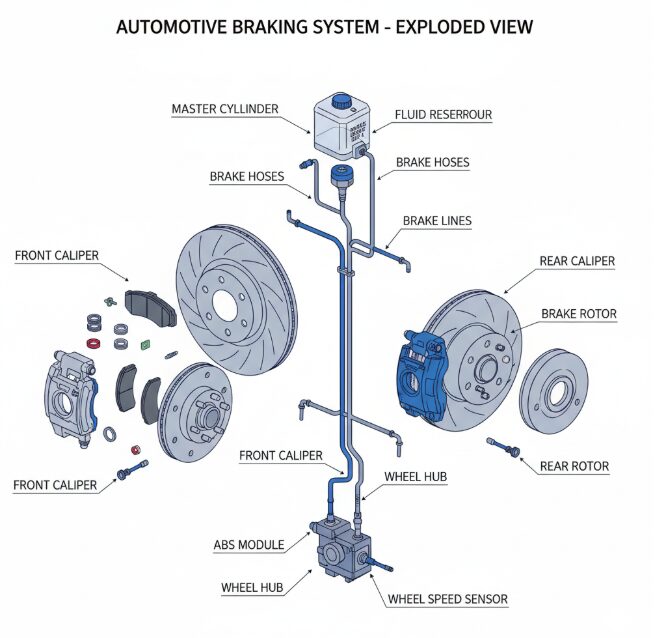
The braking system is a whole system. Simply replacing the caliper with a 4-piston caliper without matching a suitable master cylinder (insufficient fluid flow will result in a “stiff” feel or long stroke), without upgrading the metal brake lines (rubber lines will expand under high pressure, resulting in a loss of braking force), and without replacing the brake fluid with high-quality fluid (the boiling point is not high enough), may ultimately result in a less effective system than a well-maintained original 2-piston caliper.
Upgrades must be systematic. Focusing solely on the number of calipers is putting the cart before the horse.
FAQs
Q: Which is better, axial or radial calipers?
A: Radial calipers are the current high-performance trend because they directly lock to the fork with bolts, resulting in better rigidity and less deformation during braking. However, this does not mean that axial calipers are necessarily bad; the key lies in the specific caliper body design and strength.
Q: Are 4-piston calipers always more expensive to maintain?
A: Yes. First, 4-piston calipers typically require two or four friction plates, which naturally increases the cost.
Secondly, with a larger number of pistons, the disassembly, assembly, and cleaning of the seals and pistons during maintenance are more complex.
Q: Can I replace the 2-piston calipers on the front wheels with 4-piston calipers while keeping the rear wheels unchanged?
A: Of course. The front wheels are the primary source of braking force (accounting for 70%-90% of the total braking force), so upgrading the front wheels is the most effective way to improve braking performance.