 Motomaxsfr


Search Product
520 vs 525 vs 530 Chain Dimensions & Specifications
Introduction
“520, 525, 530” are the three most common specifications for Motorcycle Chain Dimensions. They are not just numerical distinctions, but a complete system of 3 core parameters Diameter Pitch, Inner Width, and Roller. By understanding the meaning behind these numbers, you can determine which chain is best for your Motorcycle and avoid potential safety hazards caused by inconsistent specifications.
This article will deeply analyze the similarities and differences between 520, 525 and 530 chains from the perspectives of principle, size, performance and application scenarios, so that you can make the most reasonable choice between lightweight and strength.
What Are Motorcycle Chain Dimensions?
What are the “520”, “525” and “530” of motorcycle chains “?
They are a very intuitive and important coding system, directly related to whether your chain can perfectly match your motorcycle and how much load it can withstand.
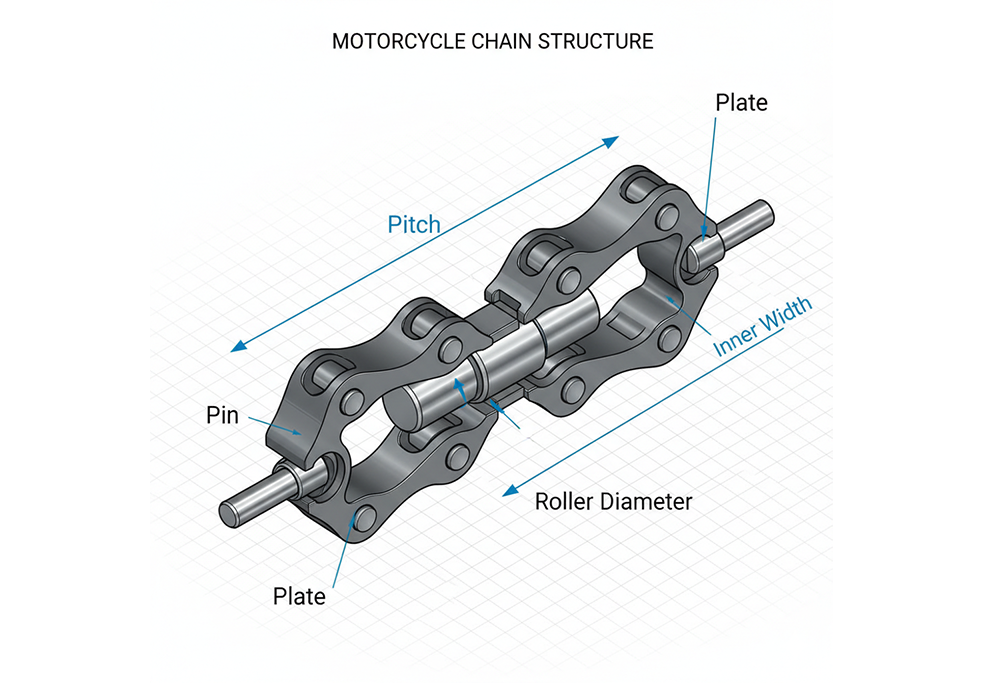
In simple terms, this three-digit code carries the 3 core size information of the chain:
- The first number (5): represents the Pitch of the chain. The “5” here actually means 5/8 inch. Pitch is the distance from the center of the chain pin to the center of the next pin. This value is fixed. For the “5” series chain, it is always 5/8 inch, which is about 15.875mm. Therefore, whether it is 520, 525 or 530, their pitch is the same. This is the basis of the chain size. If the pitch is wrong, the chain will not fit the toothed disc at all.
- The last two digits (for example, 20, 25, 30) represent the Internal Width and Roller Diameter of the chain. It needs to be expanded a little here, because different manufacturers and standards may have a slight emphasis on the interpretation of the latter two, but the core idea is to express the “stout” degree of the chain.
Internal Width: This is the distance between the inner chain plates, which determines whether the chain can be smoothly installed on your front and rear chainplates. If the inner width is too narrow, the chain will get stuck; if it is too wide, the chain will shake again, reducing efficiency.
Roller Diameter: The roller is the part that directly engages with the toothed disc. The size of the roller diameter affects the contact area and wear characteristics of the chain and the toothed disc.

520 Chain:
- “5”: indicates that its pitch is 5/8 inch (15.875mm).
- “20”: This usually means that its inner link width is about 2/8 inch, which is 1/4 inch (6.35mm). As for the roller diameter, it will match this width, usually around 7.77mm.
525 Chain:
- “5”: The pitch is still 5/8 inch.
- “25”: The width of the inner link will be larger, usually 5/16 inch (7.94mm). The corresponding roller diameter will also be larger, usually around 10.16mm.
530 Chain:
- “5”: Pitch is still 5/8 inch.
- “30”: The width of the inner link is 3/8 inch (9.525mm). The roller diameter is the largest, usually around 10.16mm.
When choosing a chain, we must pay attention to these 3 parameters:
Pitch: This is the most basic and determines the length unit of the chain. If the pitch does not match, the chain cannot be installed at all.
Internal Width: This determines whether the chain can be correctly accommodated between the toothed discs. Too narrow will card, too wide will loose.
Roller Diameter: affect the meshing accuracy and bearing capacity of the chain and the toothed disc.
Detailed Dimensions Comparison for 520, 525 and 530 Chain
When choosing a chain, it is not enough to just know the model, we need to understand the specific size parameters behind them.
520 Chain Dimensions:
520 chain, in my opinion, is the first choice for the pursuit of extreme performance and lightweight. It performs well on the track and off-road scenarios, but at the same time it has higher requirements for daily maintenance.
Specific parameters:
- Pitch: 15.875mm (5/8 inch). This is the distance between the centers of the chain pins. The pitch of all motorcycle chains is this standard.
- Inner Plate Width: 6.35mm. This width directly affects the engagement of the chain with the chainring.
- Roller Diameter: 10.16mm. The contact area between the roller and the toothed disc is related to the transmission efficiency.
- Pin Diameter: usually between 4.45mm and 5.00mm, different brands and strength levels will vary.
- Outer Plate Thickness: usually about 2.0mm.
- Inner Plate Thickness: usually about 2.0mm.
The relatively small inner link width and roller diameter of the 520 chain means that it has a lighter weight. This is essential to reduce the unsprung mass, improve acceleration response and handling flexibility. However, the smaller size also means that for the same material strength, the tensile strength and fatigue life will be slightly lower than that of a stronger chain. When I was refitting the 1 mid-displacement sports car, I deliberately chose the 520 chain. The lightness of acceleration was obvious.
The 520 chain is mainly suitable for small and medium-sized sports cars (such as 250cc-600cc high-performance models), field off-road vehicles, sliding tire vehicles and some lightweight modified street cars. Its advantage is to minimize transmission loss, so that every 1 of the engine’s power can be more directly transmitted to the rear wheels.
525 Chain Dimensions:
525 chain, if I may use one word to describe it, is “balance”. It finds an excellent compromise between strength, weight and durability, and therefore has the widest applicability on the market.
Specific parameters:
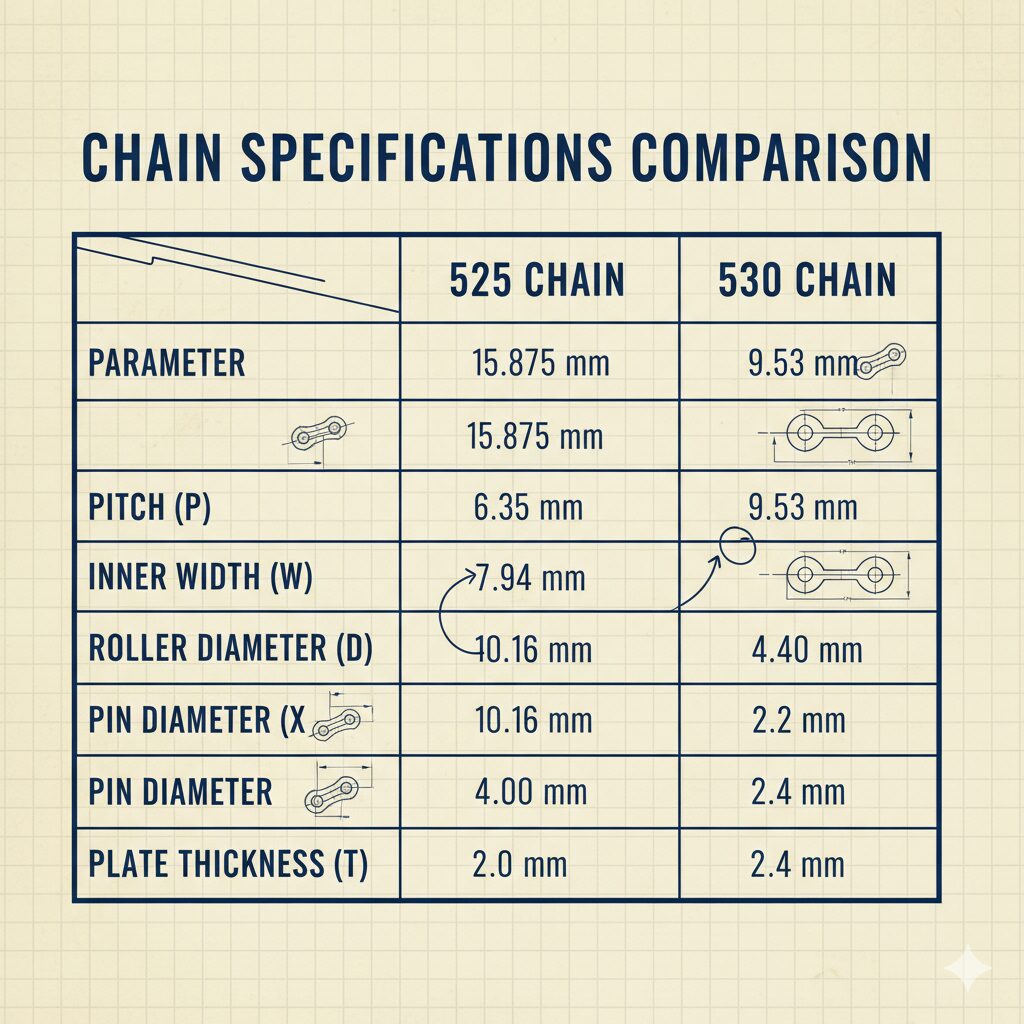
- Pitch: 15.875mm (5/8 inch).
- Inner Plate Width: 7.94mm. It’s wider than 520.
- Roller Diameter: 10.16mm. Same with 520.
- Pin Diameter: usually between 5.20mm and 5.50mm.
- Outer Plate Thickness: usually about 2.2mm.
- Inner Plate Thickness: usually about 2.2mm.
Compared with 520,525 chain, the most significant improvement is the width of the inner chain link. This directly increases the lateral rigidity of the chain and the support area of the toothed disc, thereby improving its tensile strength and impact resistance. Although it is slightly heavier than the 520 Chain, this increase in weight brings stronger durability and longer service life, especially when dealing with frequent acceleration and deceleration and high torque output, the performance of the 525 Chain will be more stable and reliable. I think that for most users, 525 Chain is the best choice for daily riding and occasionally intense driving.
525 chain is the most common chain specification on the market, which is widely used in most medium displacement street cars, sports station wagons, some high-performance recreational vehicles and many 600cc-1000cc sports cars. Its universality lies in its ability to take into account the needs of different driving styles and road conditions, whether it is urban commuting or long-distance motorcycle travel, it can provide reliable power transmission.
530 Chain Dimensions:
530 chain is for those who pursue the ultimate strength and unparalleled durability of heavy-duty motorcycles born. It represents the “muscle” of the chain drive system “.
Specific parameters:
- Pitch: 15.875mm (5/8 inch).
- Inner Plate Width: 9.53mm. This is the widest of the three chains.
- Roller Diameter: 10.16mm. Same as 520 and 525.
- Pin Diameter: usually between 5.80mm and 6.00mm.
- Outer Plate Thickness: usually about 2.4mm.
- Inner Plate Thickness: usually about 2.4mm.
With its widest inner links and thicker pins, 530 chains have the highest tensile strength and the longest fatigue life. The larger contact area and stronger structure make it easy to cope with the huge torque and instantaneous impact generated by the large displacement engine. Although this means more weight and slightly higher transmission inertia, it is a worthwhile sacrifice for models with extremely high requirements for reliability and durability. When designing heavy-duty drive trains, 530 Chain is almost the default option.
530 chains are mainly suitable for large-displacement, high-torque motorcycles, such as heavy-duty cruisers (such as many Harley-Davidson models), large-displacement street cars, and some sports station wagons over 1000cc. For these “behemoths”, 530 chains provide unparalleled reliability and safety, ensuring stable and efficient power output in a variety of harsh driving conditions.
For more detailed technical charts and compatibility guides, visit:
Motorcycle Chain Sizes Dimensions Explained
520 vs 525 vs 530 Chain:What are they different?
520 vs 525 vs 530 Chain: Strength, Weight and Durability
We all know that the chain is the core component of the motorcycle transmission system, and its size directly determines its carrying capacity and durability. Simply put, the larger the number, the wider and heavier the chain is usually, and of course, the stronger it is.
| Characteristic | 520 Chain | 525 Chain | 530 Chain |
| Tensile Strength | Moderate, suitable for small to medium displacement or lightweight-focused models | Stronger, balancing strength and weight, widely applicable | Strongest, designed for large displacement, high-torque models |
| Fatigue Life | Good under normal use, but potentially shorter in high-stress conditions | Excellent, an ideal choice for daily riding and some track use | Outstanding, capable of withstanding the most severe riding conditions |
| Weight | Lightest, helps reduce unsprung mass and improves handling response | Medium, a compromise between performance and efficiency | Heaviest, but the safety benefits of its strength far outweigh the weight impact |
Transmission efficiency: From a purely mechanical point of view, the difference in transmission efficiency of different size chains is minimal or even negligible. The main efficiency loss depends more on the lubrication condition of the chain, the tension and the design of the O/X oil seal.
Wear and life: This is a key point. The wear of the chain mainly occurs between the pin shaft and the sleeve, as well as the roller and the sprocket tooth surface. Larger chains can provide a larger contact area and stronger shear resistance due to their larger pin diameter and sleeve wall thickness, resulting in a longer life expectancy under the same operating conditions. Of course, this is only a theory, the actual life is also greatly affected by maintenance, riding environment and style.
Difference Between 520 and 525 Chain:
The 520 chain is usually regarded as a “performance-oriented” choice. It is lighter, reduces the unsprung mass, and makes the vehicle appear more sensitive in acceleration and handling. The 525 chain is more inclined to balance and durability. It has improved in strength and is more suitable for daily riders who have higher requirements for chain life or have a slightly larger vehicle displacement.
520 vs 530 Chain:
There are huge design and application differences between 520 and 530 chains, and they are absolutely not interchangeable. 530 chains are designed for heavy motorcycles with large displacement and high torque, such as public upgrade imitation racing or heavy cruising vehicles. Its pin shaft, sleeve and roller are much stronger than the 520 chain, and can withstand the tensile force and impact force far exceeding the 520 chain.
Incorrect installation of a 520 chain on a motorcycle that requires a 530 chain is tantamount to putting your life in danger. When the vehicle has a large torque output or emergency braking, the 520 chain is very likely to break because it cannot withstand the huge stress instantly. Chain break will not only lead to power interruption, more likely to wind the rear wheel, causing the vehicle out of control, the consequences are disastrous.
How to choose the right motorcycle chain?
Matching factory specifications: this is the most basic and most important principle. At the beginning of the design, your motorcycle manufacturer has already matched the most suitable chain specifications for you according to the power output, weight and intended use of the vehicle. Therefore, please be sure to consult your motorcycle user manual or maintenance manual and choose according to the manufacturer’s recommendations. The original factory’s recommendations, usually extensively tested and verified, are the safest choice.
Consider modification: If you have made a major modification to the engine, such as brushing the ECU to increase the horsepower and torque, or replacing the engine with a larger displacement, then you need to re-evaluate the chain requirements. At this time, it may be necessary to upgrade from 520 chain to 525 chain, or even from 525 chain to 530 chain, to ensure the reliability of the transmission system. Of course, if you are for track competition, the pursuit of extreme lightweight, and are willing to bear more frequent maintenance costs, in the case of ensuring sufficient safety margin, sometimes there will be extreme cases from 525 chain to 520 chain, but this requires very professional knowledge and strict testing.
- Lightweight (520 Chain): Improve handling and acceleration response, but the life may be slightly shorter, and the cost may increase due to the increase in replacement frequency.
- Balance (525 Chain): Taking into account the strength and weight, it is an ideal choice for most medium-displacement models and daily riding, with high cost performance.
- Extreme Strength (530 Chain): Suitable for large displacement, high torque models, providing the highest safety and durability, but also the highest weight and cost.
I usually advise riders that unless you have a very clear understanding of your modification and riding needs and are willing to take the corresponding risks, try not to “downgrade” the chain at will on the basis of the original manufacturer’s recommendations.
Brand and material: The brand and material of the chain are equally important. Well-known brands of products in the manufacturing process, material selection and heat treatment have strict quality control, usually can provide better performance and longer life. In addition, oil-sealed chains with O-rings, X-rings or Z-rings can effectively lock grease, block dust and moisture, significantly extend chain life and reduce maintenance frequency. I personally prefer X-ring chains. I think they have a better balance between friction loss and tightness.

Frequently Asked Questions About Motorcycle Chain Dimensions
Q1: How can I know which chain size my motorcycle uses?
A: The most reliable way is to check your owner’s manual or the label on the swingarm. The manufacturer specifies the correct chain size (e.g., 520, 525, or 530) that matches the sprockets and drivetrain design. Always follow the OEM specification to ensure perfect fitment and safety.
Q2: Is a 520 chain always better because it’s lighter?
A: Not necessarily. A 520 chain is lighter and can improve acceleration and handling response, making it popular in racing or performance tuning. However, it sacrifices some strength and longevity, making it less suitable for high-torque or heavy motorcycles.
Q3: Can I replace a 530 chain with a 525 or 520 chain?
A: Technically yes, but it’s not recommended unless you know exactly what you’re doing. You must also replace the front and rear sprockets to match the new chain width. More importantly, ensure the smaller chain can handle your bike’s torque; otherwise, it may snap under load and cause severe damage or injury.
Q4: Why do 520, 525, and 530 chains all have the same pitch?
A: Because they all belong to the “5-series” family, where the pitch is standardized at 5/8 inch (15.875 mm)
Conclusion:
520, 525, 530 three specifications and no absolute advantages and disadvantages, only the “most suitable” choice.
If you pursue lightness and sensitivity, 520 chain is the best partner. If you want to give consideration to strength, life and economy, 525 chain is almost the universal answer. In the face of the demand of strong torque and long-distance high load, 530 chain is synonymous with safety and stability.
Remember: following the original factory specifications, doing daily maintenance, and regularly checking wear and tear can ensure driving safety and lasting smooth power transmission more than blindly pursuing “upgrades.
About Author
Alex Chen is a mechanical engineer specializing in the design and testing of motorcycle drivetrains. With many years of chain structure and performance research experience, he combines professional engineering knowledge with riding practice to help owners better understand the impact of chain selection on safety, durability and power performance.
Related Reading:
How To Tighten A Dirt Bike Chain
How To Measure Sprocket Size
Does A Smaller Sprocket Increase Speed
How To Clean Motorcycle Chain
How Many Miles Does A Motorcycle Chain Last
Can A Loose Motorcycle Chain Cause Vibration
Do You Need A Chain Guard On A Motorcycle
Do All Motorcycle Chains Have A Master Link
How To Know If Motorcycle Chain Is Bad
How To Determine Motorcycle Chain Size
How To Check Your Motorcycle Chain
How To Get Rid Of Rust On Motorcycle Chain
loading…
已经是到最后一篇内容了!
Related recommendations
-

How Long Does A Motorcycle Chain Last
380Find out how long a motorcycle chain lasts, the factors affecting lifespan, and maintenance tips to ensure safety.
View details -
How often should i lube my motorcycle chain
443Learn how long a motorcycle chain lasts, factors that affect its lifespan, and tips to maintain it for safe riding.
View details -
How Long Does A Motorcycle Chain Last: The Ultimate Guide
416Find Out How Long A Motorcycle Chain Lasts, Factors That Affect Its Lifespan, And Maintenance Tips To Ensure Safety.
View details -
How To Measure Motorcycle Chain Slack
258Learn How To Measure Motorcycle Chain Slack In Minutes. Ensure Your Bike Runs Safely And Performs Perfectly.
View details
Expand more!