Motomaxsfr


Search Product
Does A Smaller Sprocket Increase Speed
The answer depends entirely on which toothed disc you are moving.Changing to a smaller rear gear will increase your top speed; and changing to a smaller front gear will reduce the top speed, but can significantly improve the starting acceleration. Reducing the rear gear plate allows the engine to run a longer distance per revolution at a lower speed, which is what we often call the “elongated” transmission ratio. Conversely, if you reduce the number of teeth on the front output gear, you are actually shortening the final drive ratio, which can bring more low torque and starting “explosive power”, but at the expense of speed. To achieve the perfect balance of performance, you must understand a basic logic: every yard of speed obtained by reducing the rear gear is at the expense of starting power and throttle response.
Understand The Relationship Between The Size Of The Toothed Disc And The Speed
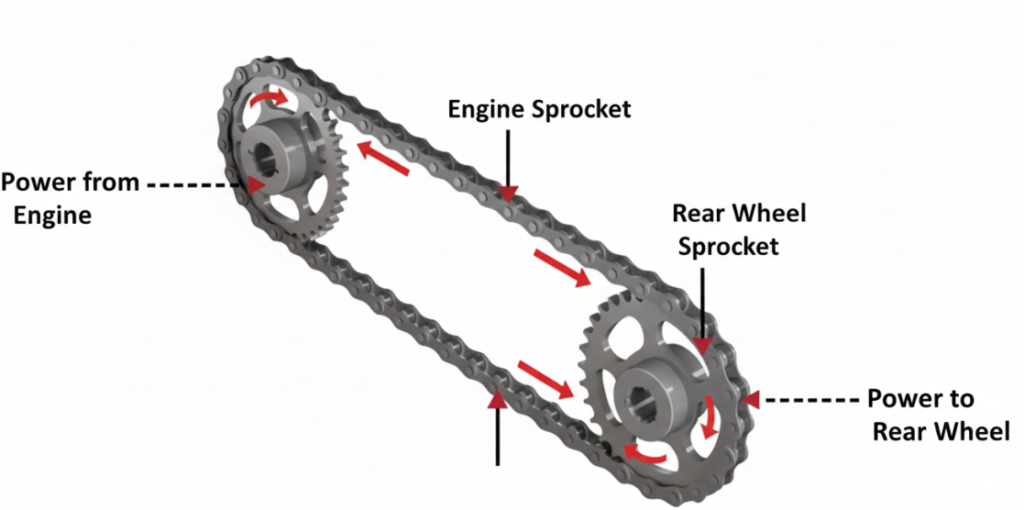
To understand why the shrinking gear has very different effects in different positions, we have to look at the “final drive ratio” . In the chain transmission system, the engine drives the front gear plate (output shaft gear plate), and the front gear plate pulls the rear gear plate to rotate through the chain. When you change the number of teeth on any toothed disc, you are essentially changing the ratio of “how many revolutions does the engine need to make the rear wheel turn a full. This is always a trade-off game between torque and end speed.
Why Does Shrinking The Toothed Disc Increase The Top Speed?
If your goal is to run faster, reducing the back gear is the most common modification method, which is often referred to in the industry as “increasing the transmission ratio”.
Mechanical principle: the smaller back tooth plate in the rotation of the number of chain links required less. This means that for every turns of the front gear, the rear wheels will travel farther than before the modification.
Speed management: By reducing the number of rear teeth, the engine can maintain a lower speed at cruising speed. This “lengthens” the stroke of each gear, allowing you to reach a higher limit speed before touching the engine’s red line speed.
Trade-off: The speed is faster, but you lose the advantage of mechanical leverage. I dare say that after the modification, you will obviously feel that the vehicle has become “fleshy” at the start, and it will take longer and more effort to push to that high speed.
Why Does Shrinking The Front Gear Disc Reduce The Speed?
On the contrary, the installation of a smaller front gear plate produces the exact opposite effect, which is called “shortening the transmission ratio”.
Increased torque: The smaller front gear makes the engine spin easier. The effort required to drive the chain is reduced, which directly translates into strong low-speed torque and “momentum” at start “.
Reduce the end speed: because the front gear becomes smaller, it must turn more turns to drive the rear wheel turns. As a result, you will reach the engine’s maximum speed (fuel cut-off point) much faster than before, thus reducing the overall top speed.
Ideal use scenario: This modification is very popular with off-road motorcycle or technical forest road riders. In these scenes, the instantaneous explosive force after the turn is much more important than the speed.

Finding The Best Performance Balance
Reducing the gear plate is not the “pantheon” scheme. How to choose depends on your actual needs:
High-speed cruise: If you find that the engine “roars” badly on the highway, change to a smaller rear gear plate to reduce the speed and increase the speed by the way.
Quick start: If you think the car is too heavy or the response is slow when you turn the throttle, a small front gear plate can give you the low-speed explosive power you want.
Industry experience guidelines: There is an unwritten proportion in the transmission modification industry: the front gear plate changes 1 tooth, which is roughly equivalent to the rear gear plate changes 3 teeth. Due to the small base of the front toothed disc itself, moving any 1 teeth on it will bring about far more drastic changes than the rear toothed disc.
Author: Alex Miller
“I’m a power sports enthusiast and mechanical specialist with years of experience in performance tuning. I’m passionate about helping riders understand the physics of their machines—specifically how fine-tuning gear ratios and final drive setups can strike the perfect balance between raw acceleration and maximum top speed. “
The prev: How To Clean Motorcycle ChainThe next: How To Measure Sprocket Size
Related recommendations
-

Can I Use Bicycle Chain Lube On A Motorcycle Chain
317The Short Answer Is No. Bicycle Lube Lacks Viscosity And Will “Fling Off” Immediately. Find Out Why It Risks Damaging Your O-Rings.
View details -
Type Of Motorcycle Chain Explanation
310Explanation Of The Differences Between Standard, O-Ring, And X-Ring Motorcycle Chains.
View details -
How To Clean Motorcycle Chain
181Learn How To Clean Your Motorcycle Chain Safely To Extend Its Life. Step-By-Step Guide On Degreasing And Lubing.
View details -
Are Gold Motorcycle Chains Better
249Are Gold Motorcycle Chains Better? Yes. Titanium Nitride Plating Resists Rust, Cuts Friction, And Extends Life. See Why It’S Worth It.
View details