 Motomaxsfr



Buscar producto
¿Para qué se utilizan las ruedas dentadas?
This is a kind of toothed wheel, specially designed to engage with the chain, mainly to solve the situation that the two shafts are too far away to be directly docked with gears.
In practice, the core value of the sprocket is its transmission efficiency. Unlike gears that must gnaw each other “face to face”, sprockets rely on roller chains to cross the space, bringing power from the driving end (such as the engine of a motorcycle) to the driven end (such as the rear wheel).
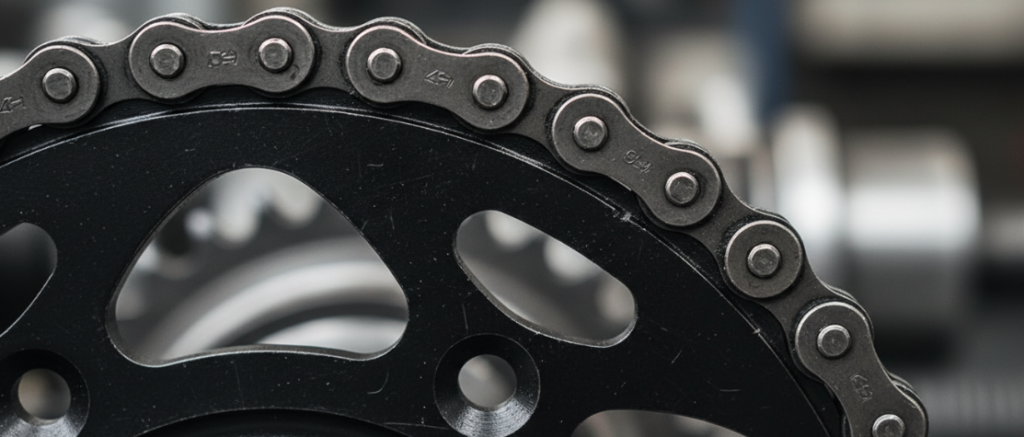
Mechanical Principle Of Chain Interaction And Rotary Motion
This is completely different from the logic of pulleys driven by friction. Each tooth on the sprocket is precision machined so that it can be snapped into the gap of the chain. This design has an irreplaceable advantage in preventing slippage. When the drive shaft rotates, the sprocket teeth will mechanically hook the chain. Because of this “hard locking” relationship, every angle of the input shaft will be transmitted to the chain without loss, and then drive the output shaft. As long as it involves equipment with dead requirements for timing or constant speed, sprocket is basically the only reliable choice.
Sprocket Vs. Gear: Solving The Distance Puzzle
As mentioned earlier, the sprocket is often selected because “the distance is too far to apply the gear”. This is the watershed that distinguishes the sprocket system from the gear system.
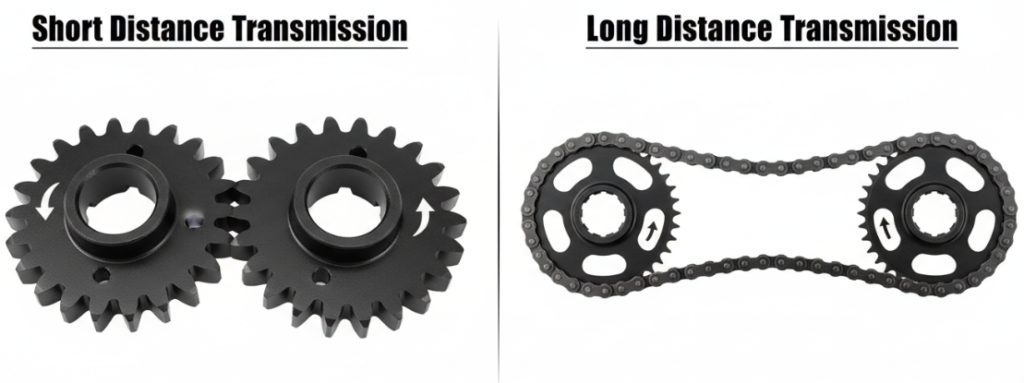
Direct Contact vs. Spanning Space: Gear drives must rely on direct contact between the teeth, which forces the two shafts to be very close together.
The bridge function of the roller chain: the sprocket uses the chain to build a “bridge” between the two shafts “. This allows engineers to put the engine a little further away from the driving wheels. If you have to use gears to connect two shafts that are far apart, then you have to put on a whole row of gears. The weight, cost, and friction loss generated in the middle are all overwhelming. Sprockets with a light chain to solve these problems, even if the distance is very long, can maintain a high efficiency.
Piñones
Las pinzas de freno, los piñones y las cadenas están disponibles a granel.
Serie Caliper
Menor peso, resistencia a la corrosión, resistencia al deslizamiento
Serie Cadena
Las pinzas de freno y los piñones ofrecen un rendimiento excelente.
Cadena Serie 520VX2
Escenarios ciclistas: calle, recorridos en moto por carretera, conducción urbana.
Actual Combat Case: Motorcycle Drive System
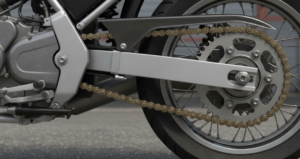
Motorcycles are probably the easiest example for everyone to understand the use of sprockets. It perfectly shows how to convert the torque of the engine into speed and acceleration. In this system, usually two sprockets work together:
Small flywheel (drive sprocket): mounted on the engine output shaft. It carries the original power and torque generated by the combustion of the engine and drives the chain to rotate.
Rear sprocket (driven sprocket): mounted on the rear hub. When the chain pulls the teeth of the rear sprocket, the rear wheel is forced to rotate and the car runs.
Torque To Speed Conversion
There is an interesting logic here: the sprocket is actually “translating” the power. By changing the size ratio of the two sprockets (that is, the gear ratio), we can directly change the character of the car.
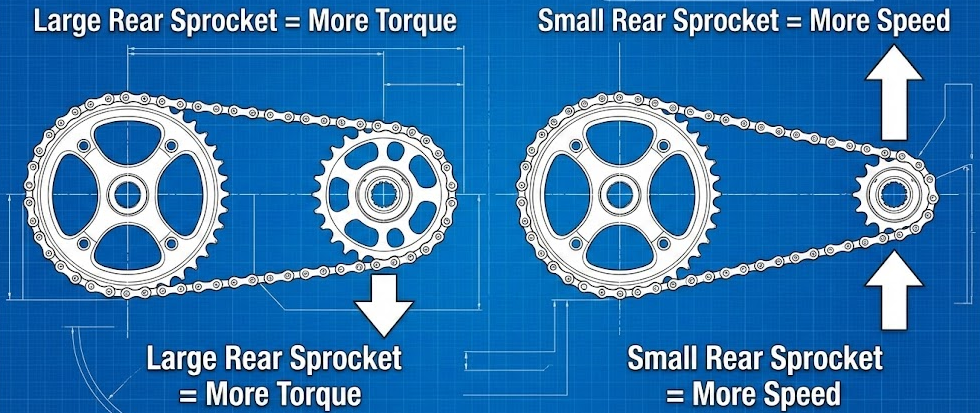
This transformation is actually a balancing act:
For acceleration: If the gear ratio is adjusted to make it easier for the system to pull the chain, the torque will be amplified, and the car will start and speed up very violently.
For extreme speed: Conversely, if you adjust the ratio so that the rear wheels can get a higher rotation frequency, the car can run a higher limit speed.
In the final analysis, the sprocket is like an accurate power translator. It transports the rotational energy from the distant engine through the chain, dripping to the place where work is really needed.
Author: Marcus Thorne
” I have spent over a decade working with industrial mechanical drive systems. My passion lies in breaking down complex engineering components—like how sprockets transmit power across distances—into clear, actionable insights for both enthusiasts and professionals in the field.”
El prev: Cómo lubricar la cadena de la moto
Recomendaciones relacionadas
-

Dimensiones y especificaciones de la cadena 520 vs 525 vs 530
712"520, 525, 530" son las tres especificaciones más comunes para las Dimensiones de Cadenas de Motocicletas. No se trata sólo de distinciones numéricas, sino de un sistema completo de 3 parámetros fundamentales: paso de diámetro, anchura interior y rodillo. Comprendiendo el significado...
Ver detalles -
¿Qué herramientas necesito para apretar la cadena de mi moto?
314Sepa exactamente qué herramientas necesita para apretar la cadena de su motocicleta, desde soportes de paddock hasta llaves dinamométricas. Hágalo bien.
Ver detalles -
Cómo cambiar una cadena de moto
44Aprenda A Cambiar Una Cadena De Motocicleta. Incluye desmontaje de eslabones, sustitución de piñones, remachado y ajustes de par.
Ver detalles -
Cómo apretar la cadena de una moto de cross
104Aprenda a apretar correctamente la cadena de una moto de cross. Ajuste la holgura a 20-30 mm y asegure una alineación perfecta de la rueda.
Ver detalles