
 Motomaxsfr



Rechercher un produit
Qu'est-ce que le pas du pignon ?
Le pas du pignon est la distance entre les centres de deux axes (ou rouleaux) adjacents de la chaîne. Pour qu'un système d'entraînement fonctionne correctement, le pas du pignon doit correspondre exactement à celui de la chaîne afin d'assurer un engagement en douceur. Généralement mesuré en pouces, un pas plus important signifie des dents d'engrenage plus grandes et une capacité de charge plus élevée. Vous pouvez identifier le pas de votre pignon en vérifiant l'estampille du fabricant (par exemple, "40" ou "520") sur la chaîne ou en utilisant un pied à coulisse pour mesurer la distance précise centre à centre entre deux goupilles.
La correspondance des pas est importante dans la transmission
Le synchronisme entre le pignon et la chaîne qui le supporte est la pierre angulaire de la transmission mécanique de la puissance. Lorsque nous parlons de "pas", nous parlons essentiellement de la géométrie, qui détermine si les rouleaux de la chaîne peuvent s'insérer parfaitement dans la rainure de la dent (c'est-à-dire le pied de la dent) du pignon.
S'il y a ne serait-ce qu'un léger écart entre le pas du pignon et le pas de la chaîne, l'ensemble du système s'effondre rapidement. Les problèmes sont généralement les suivants :
- Usure accélérée : La chaîne ne peut pas se loger profondément dans la rainure de la dent, mais a tendance à monter sur la pointe de la dent, ce qui provoque une augmentation de la friction.
- Défaillance mécanique : Le décalage du pas entraînera le saut de dents de la chaîne sous l'effet de la charge, voire son effondrement direct.
- Bruit et vibrations : Une personne un peu avertie peut dire si le pas est correct en écoutant le son. Le bruit de fonctionnement inadapté est très dur, et ces vibrations à haute fréquence nuisent directement à la durée de vie du roulement et du moteur.

Corrélation entre la taille du pas et la capacité de charge
Le pas est un indicateur direct de la taille physique et de la résistance du pignon. Dans le domaine de la transmission de puissance, la taille est souvent directement égale à la capacité.
- Petit terrain : Plus courant dans les instruments de précision ou les scénarios à haute vitesse et à faible couple (comme les bicyclettes ou les petits appareils électroniques). Cette spécification permet une conception plus compacte, mais avec une limite supérieure de résistance à la traction plus basse.
- Grand emplacement : Fréquente dans les machines industrielles lourdes, les convoyeurs et les motos. Un grand pas signifie que les dents du pignon sont plus épaisses et que les axes de la chaîne sont plus épais. Cette configuration est conçue pour résister à un couple élevé et à une charge importante, et les pièces métalliques ne sont pas sujettes à la déformation plastique sous une forte pression.
Interprétation des pierres des fournisseurs (ANSI et ISO)
La plupart des pignons et des chaînes de qualité professionnelle sont marqués d'un code spécifique, qui vous permet de connaître le pas en un coup d'œil. La maîtrise de ces lois numériques est le moyen le plus rapide d'identifier le matériel.
Pour la chaîne standard ANSI (American National Standards Institute), il existe ce que l'on appelle le "principe des 8 points" : le premier chiffre représente un multiple de 1/8 de pouce.
- 40 Chaîne / pignon : Le pas est de 4/8 de pouce, ou 1/2 de pouce.
- 60 chaîne/pignon : Le pas est de 6/8 de pouce, ce qui correspond à 3/4 de pouce.
- 80 Chaîne / pignon : Le pas est de 8/8 de pouce, soit 1 pouce.
Dans le domaine des motocycles, les codes les plus courants sont 520 ou 530. Le premier chiffre "5" représente un pas de 5/8 de pouce, tandis que les deux chiffres suivants représentent la largeur entre les plaques du maillon intérieur.
Comment mesurer avec précision le pas des pignons
Si l'équipement fonctionne depuis trop longtemps et que le cachet du fabricant est usé et estompé, il faut s'en remettre à la mesure manuelle. À ce moment-là, la précision est essentielle, car une erreur de quelques dixièmes de millimètre peut vous amener à choisir la mauvaise norme lors de la commande de pièces détachées.
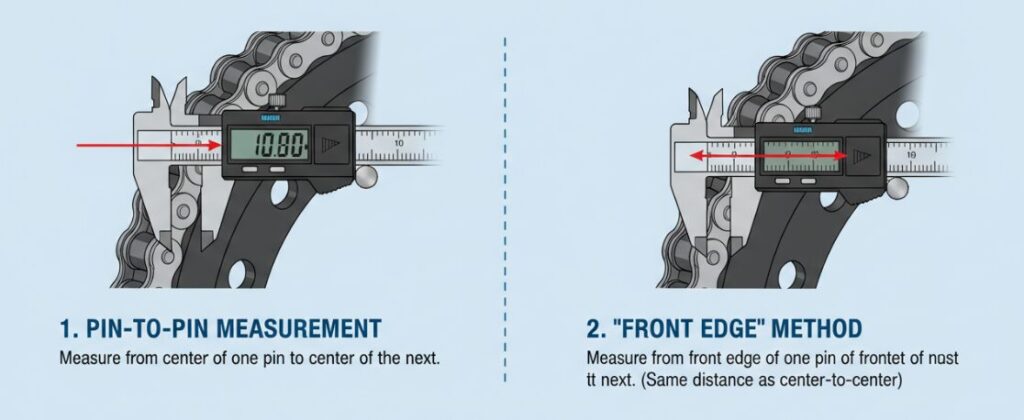
Mesures précises avec les pieds à coulisse :
Pour obtenir une lecture précise, vous pouvez suivre les étapes suivantes :
- Mesure broche à broche : Placez la pointe du pied à coulisse au centre exact d'une goupille et mesurez la distance jusqu'au centre de la goupille adjacente suivante.
- "2.1" méthode : S'il est difficile de trouver le centre de la goupille, vous pouvez mesurer le bord avant d'une goupille jusqu'au bord avant de la goupille suivante. Cette distance est exactement la même que l'entraxe, mais elle est souvent plus facile à repérer en fonctionnement.
- Recoupement des données : Après avoir obtenu une mesure décimale (par exemple 0,50 "), celle-ci est convertie en fraction (1/2") afin qu'elle puisse être facilement mise en correspondance avec la bibliothèque de taille standard.
Auteur : Paul
"Bonjour, je suis un spécialiste des systèmes mécaniques avec plus d'une décennie d'expérience dans la transmission de puissance et la maintenance industrielle. Tout au long de ma carrière, j'ai manipulé d'innombrables systèmes entraînés par chaîne, des convoyeurs industriels à haut rendement aux motocyclettes à haute performance. Je suis passionné par la décomposition de concepts mécaniques complexes, tels que la géométrie des pignons et l'alignement du pas, afin d'aider les ingénieurs et les techniciens à optimiser leurs machines pour des performances et une longévité optimales."