Motomaxsfr


Search Product
Guide to Lube Motorcycle Chain:Say Goodbye to Motorcycle Chain Rust
Know Your Chain And Lubricant

The motorcycle chain type and characteristics:
Our motorcycle chains are mainly those: O-rings, X-rings and Z-rings. Don’t listen to the name is quite high, in fact, the principle is similar. They have rubber sealing rings inside the chain links. For example, the O-ring is round and the X-ring looks like an “X”.
What are these rings? To put it simply, the grease added between the pin shaft and the bushing when the chain leaves the factory is firmly locked inside, so that it is not allowed to run out or dirty things enter.
Therefore, we daily oiling the chain, mainly to lubricate the external metal parts of the chain, especially the contact between the rollers and the sprocket, as well as between the side plates, to reduce wear and prevent rust.
Why does the chain need lubrication?
This question is actually quite intuitive. Think about it. If there is no “oil and water” between metal and metal, how much friction will it be?
- Reduce the friction between metal parts and prevent wear: When the chain is working, all parts are moving and rubbing at high speed. The lubricant is like a protective film, which greatly reduces wear and extends the life of the chain.
- Anti-corrosion: The chain is made of steel, exposed in the air, especially in a humid environment, it is a matter of minutes to rust. The lubricant can form a layer of oil film, isolate air and moisture, and effectively prevent rust.
- Absorb impact and reduce noise: The chain will have an impact during the transmission process. The lubricant can play a certain buffering role, make the chain run more smoothly, and also reduce the noise when the chain is working.
How often to lube motorcycle chain?
This question, I am often asked. In fact, there is no “standard answer”, depending on the situation:
- According to the mileage: I usually suggest that the motorcycle friends have to give the chain a good service every 500 to 1000 kilometers. Of course, this is only a rough idea. If you are a “Buddhist” rider, you can extend it appropriately.
- According to the riding environment: this is very important! If you have just experienced a 1 heavy rain or run a 1 muddy cross-country road, don’t hesitate to clean the chain and relubricate it first thing when you go home. Dirt and water are the “natural enemies” of the chain “.
- According to the chain condition: sometimes you look at the chain carefully and find that it looks a little dry, or when you hear the chain making a strange noise while riding, it is also reminding you: “master, it’s time for me to eat!”
- It is suggested to check quickly before each ride: before each ride out, take a minute or two to glance at the chain to see if there is any abnormality, which will make you feel more confident.
How to choose a good motorcycle chain lube?
There are many kinds of chain lubricants on the market, and the right choice can get twice the result with half the effort:

dry lubricant vs wet lubricant:
- Dry lubricant: The solvent will volatilize after spraying, leaving a thin, non-sticky lubricating film. The advantage is relatively clean, not easy to throw oil, suitable for use in a dry, dusty environment. For example, you often commute in the city, or run paved roads, dry is good.
- Wet lubricant: It will form a thicker oil film when sprayed, with better lubrication effect, strong adhesion, and better waterproof and rust resistance. The disadvantage is that it is easy to stick dust and easily throw oil to dirty the wheel hub. If you often run long distances or go off-road, wet lubricants will be a better choice.
spray type vs brush type:
- Spray type: It is the most common, easy to use and spray evenly. Most friends like to use this.
- Brush type: rare, but can control the dosage more accurately, suitable for those who are particularly fastidious. Personally, I think the spray type is enough.
recommend famous brands and types:
- There are many good chain oils on the market, such as Motul, Liqui Moly, 3M, etc., all of which have a good reputation.
- Personally, I prefer white chain lubricant because it is white and can clearly see which places are sprayed and which are not sprayed, which is convenient for inspection.
- The most important thing is to choose an O-ring (or X-ring, Z-ring) compatible lubricant! Because non-compatible lubricants may corrode the rubber sealing ring inside the chain, it is not worth the loss.
The Correct Way To Use Motorcycle Chain Lube
To tell the truth, many car owners have misunderstandings in this respect and think that just spray it casually. That won’t do! A set of correct procedures can make your chain “energetic”.
Preparation:
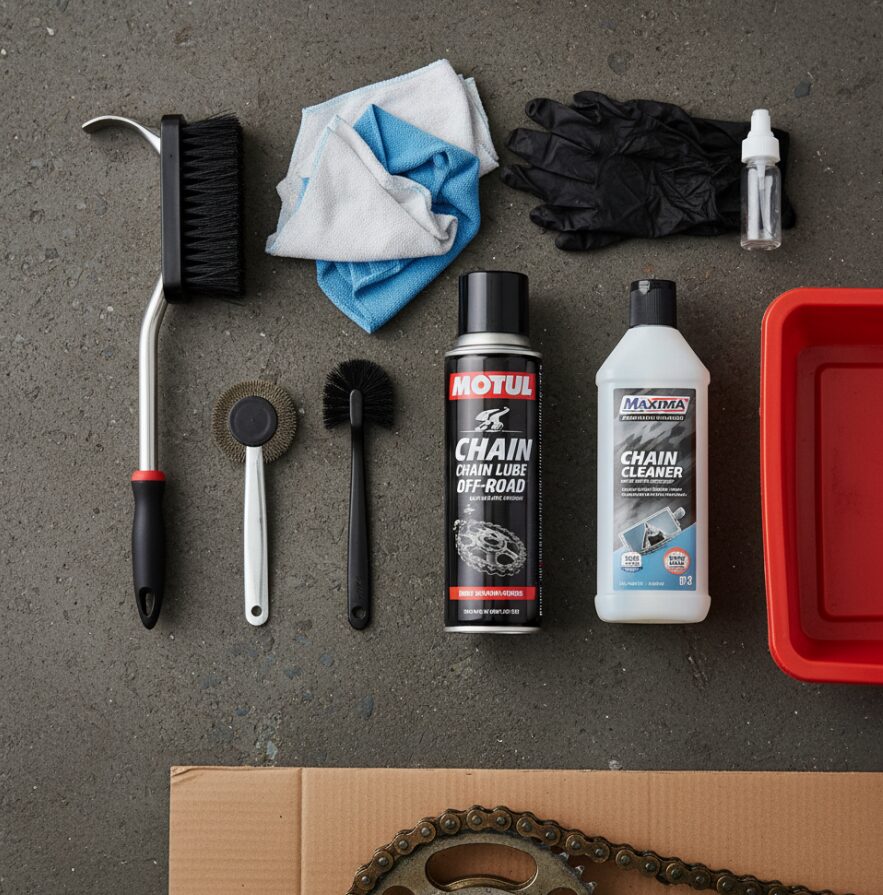
First of all, we have to get the guys ready.
- what to use to clean motorcycle chain search volume: parking frame or Paddock stand must be available, if not, side support pad high rear wheel also make do, but must ensure that the car is stable. Then there are chain cleaner, chain brush, several pieces of wiping cloth (preferably cotton cloth like old T-shirt, which has good oil absorption effect), chain lubricant, 1 pair of gloves (to protect hands, you know), and waste cardboard or old newspapers. This stuff is a good thing and can save you a lot of trouble.
- Safety first: Before starting construction, be sure to turn off the engine, put it in neutral, and then check whether the car is stable. Don’t fall down when the 1 hits it, it will do more harm than good.
Clean the chain: essential before lubrication!

I tell you, this step of cleaning the chain must not be saved!
- Why clean: the reason is very simple, you think, if the old sludge, dust and sand on the chain are sprayed with new oil directly, it will become “abrasive? It will only accelerate the wear of the chain and backfire. Therefore, cleaning up these dirty things is the key to extending the life of the chain.
- Cleaning steps:
- Put the waste cardboard under the chain first, especially in the splash zone, so that the detergent will not spray on the tire or wheel hub, saving you from having to clean the wheel hub after cleaning the chain.
- Pick up the chain cleaner and spray it evenly on the chain. My personal experience is that it’s okay to spray a little more and let the cleaner fully dissolve those stubborn dirt.
- Then came the chain brush. Don’t be lazy, the inner and outer sides of the chain and the gaps in the chain links have to be carefully brushed. I like to use the one with several brush heads, which is efficient. Pay attention to the strength when brushing, don’t break the O-ring.
- After brushing, wipe the chain clean with a clean cloth to ensure that there is no residual dirt and detergent on it. When you wipe it, you will find that the cloth is black, which means you are clean enough.
- Here comes the most important step! Let the chain dry completely. You can blow it with compressed air, or just leave it there and let it dry naturally. Never in the wet time on the lubricant, or lubricant effect will be greatly reduced.
Lubrication chain: accurate in place!

The chain is clean and dry, and then the lubricant is applied.
- Best time: After cleaning, don’t rush to ride. It is best to complete lubrication at least 15-30 minutes before riding. This gives the lubricant enough time to penetrate into the chain links and solidify a little to prevent oil flinging. I usually clean and lubricate at night, and ride directly the next morning, which has the best effect.
- Operation steps:
- Padded waste cardboard again, this thing is really an anti-oil artifact.
- If it is with a parking frame, turn the rear wheel directly. If the side support is high, you can start the engine (idling, neutral gear) and let the rear wheels turn slowly. This operation is much more convenient.
- Take the chain lubricant, align it with the inside of the chain, that is, the side close to the sprocket, and spray it evenly. Remember, the focus is on the location of the rollers and O-rings, which is the core area that needs to be lubricated.
- In the process of slow rotation of the rear wheel, let the lubricant evenly cover the entire chain. Don’t miss a place.
- Here’s a tip: don’t overspray! A thin layer is enough. Too much is not only wasteful, but also easy to throw when riding. The car body is full of oil everywhere, making it more troublesome to clean up.
Final work:

It’s all finished, don’t rush to call it a day.
- Static: Let the lubricant stand for a while to fully penetrate and solidify. This waiting time is very important, it determines the lubrication effect and the degree of oil rejection.
- Wipe: When the lubricant is almost gone, use a clean cloth to gently wipe off the excess lubricant outside the chain. The main purpose is to prevent the oil from being thrown when riding and the body dirty. But be careful not to wipe it too clean, and wipe off the lubricant that has just penetrated.
Frequently Asked Questions And Advanced Tips
The chain lubrication common errors:
- Only lubricate not clean. Ah, this is the most common mistake I have ever seen. Many riders feel that everything will be fine as long as they spray lubricant, completely ignoring the cleaning step. If the dust, sand, and old oil stains on the chain are not cleaned up, spraying lubricant directly will only “seal” these dirty things inside the chain. 1 a long time, it will accelerate wear and the effect will be counterproductive. So, remember, cleaning is always the first step!
- Use oil, butter and other unsuitable chain lubricants. Brothers, chain lubricant is specially designed for chains and has its special formula. I ‘ve seen a lot of friends save time by putting oil or even butter on the chain. This practice should absolutely be avoided! The engine oil is too thin, it is thrown everywhere, and it is easy to stick ash. Butter is too thick, permeability is poor, and it is easy to adhere to a large amount of dust, which is harmful to the chain. Professional things still need to use professional tools, and choosing the 1 qualified chain lubricant is the right way.
- Lubricant sprayed too much. The right amount is good, there is really no need to spray like rain. Spraying too much is not only a waste, but the excess lubricant will be thrown everywhere, not to mention dirtying the body and wheel hub. It is also easy to absorb dust and form sludge, which becomes a burden. My experience is to spray evenly on the inside of the chain so that it can fully penetrate.
- Lubricate immediately after riding. After the lubricant is sprayed, it takes some time for it to penetrate, adhere, and evaporate the solvent. I generally recommend that riders wait at least 15-30 minutes, or even longer, depending on the type of lubricant you use. If you ride right away, most of the lubricant will be thrown off at high speed, and the effect will be greatly reduced.
Rust on motorcycle chain and unusual noise: what should you do?
Competition Degree: 6%)
- Abnormal sound: the abnormal sound of most chains, my experience is usually caused by lack of oil or incomplete cleaning. Don’t panic, follow the steps we mentioned earlier, thoroughly clean 1 times, and then lubricate evenly. Generally speaking, abnormal noise can be solved. If not, it may be necessary to check the chain for other damages.
- Slight rust: If there is only a slight rust on the surface, you can try to clean it carefully with a professional chain cleaner and a brush, and then fully lubricate it. In many cases, slight rust can be removed. But if the corrosion is serious and the chain links are stiff, then my advice is, don’t hesitate, for the sake of safety and riding experience, consider replacing it directly. The chain is an important part of the transmission system and cannot be sloppy.
Inspection of motorcycle chain loose symptoms and adjustment:
To be honest, chain lubrication and maintenance are periodic work, but the tightness of the chain is also critical. I usually check it every time I lubricate. Under normal circumstances, the free stroke of the chain in the middle position should be about 2-3cm.
Friendly reminder: If you find that the tightness of the chain is inappropriate, too loose or too tight, you need to adjust it at this time. This adjustment process is a little more complicated. If you are interested, I can write 1 article on chain tightness adjustment in the future, or you can also find relevant professional tutorials to learn. Improper adjustment may affect riding safety and chain life.
Handling of special cases:
- Rainy Ride After: It’s Important! Ride on rainy days, the rain will wash away the lubricant on the chain, and may also bring in sediment. So, after riding home on a rainy day, be sure, and I mean be sure, to clean and relubricate the chain. Don’t be lazy, this can greatly extend the life of the chain.
- Before long trips: Before each long trip, I carefully check the chain 1 times, including cleaning, lubrication and tightness. After all, problems on the road are no laughing matter. Make sure that the chain is in good condition so that you can enjoy the journey with peace of mind.
The prev: How long does a motorcycle chain lastThe next: Motorcycle Brake Caliper Maintenance Guide
Related recommendations
-

How Often To Clean And Lube Motorcycle Chain
336How Often To Clean And Lube Motorcycle Chain? A Mechanic Explains The 300-600 Mile Rule And Why Rain Changes Everything.
View details -
Are Motorcycle Chains Universal
300No, Chains Are Not Universal. “Universal” Only Refers To Length. You Must Match Specific Pitch, Width, And Strength.
View details -
525 Motorcycle Chain: Size, Strength, Master Link & Kit Guide
633Compare 520 vs 525 chain dimensions, strength, and durability. Find the best 525 motorcycle chain and sprocket kit.
View details -
Are Gold Motorcycle Chains Better
274Are Gold Motorcycle Chains Better? Yes. Titanium Nitride Plating Resists Rust, Cuts Friction, And Extends Life. See Why It’S Worth It.
View details