 Motomaxsfr


Search Product
How Motorcycle Sprockets Work
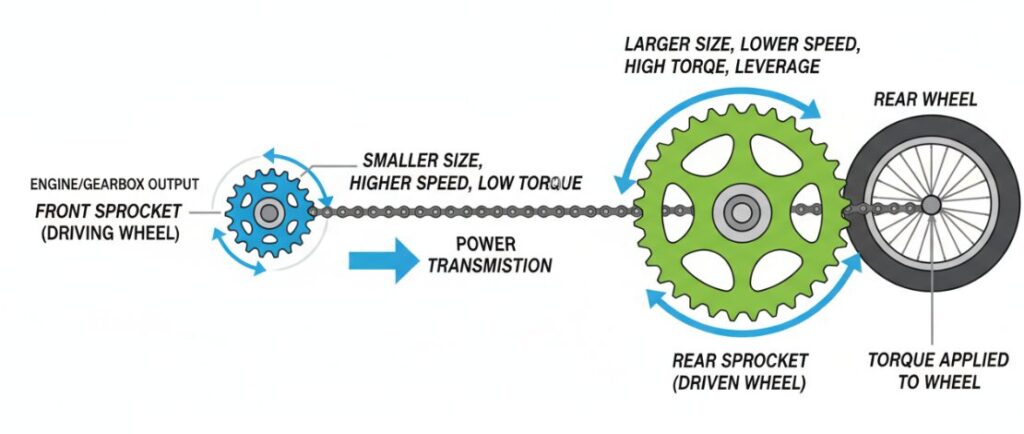
Motorcycle sprockets work by transferring rotational power from the engine to the rear wheel through a chain drive system. As the engine turns the smaller front sprocket (countershaft), it pulls the chain to rotate the larger rear sprocket. The relationship between their sizes creates a “Gear Ratio” that determines performance: a higher ratio (larger rear sprocket) increases acceleration/torque, while a lower ratio improves top speed.
This video visually explains how sprockets affect motorcycle performance:
Chain Transmission System
To really understand how the tooth plate works, we have to look at the so-called “final drive” circuit. You can think of it as a bridge between the engine’s power output and the road surface. This process begins with the gearbox, which turns the output shaft, which is directly connected to the front tooth plate (we usually call it the countershaft tooth plate). When the front crankset rotates, its teeth engage the links of the chain. The chain is like a continuous belt, pulling the force back and transmitting it to the rear tooth plate bolted to the rear hub. This hard connection ensures that every revolution of the engine is actually converted into the action of the rear wheels.
The Role Division Of Anterior And Posterior Dental Discs
Although they are both toothed wheels, size and position determine their very different “personalities”:
Front tooth disc (secondary shaft): smaller, is the “driving wheel”. Because it is small, it must rotate at high speed to match the output rhythm of the engine gearbox.
Back tooth plate: much larger, is the “driven wheel”. It is precisely because of its large diameter that its speed is slower than that of the front tooth disc, but it can exert greater leverage (that is, torque) on the wheels.
The “Gear Ratio” Is The Key
How does the tooth plate determine the performance of the motorcycle? The core lies in the “tooth ratio”. The formula is very simple:
Number of teeth on posterior disc ÷ Number of teeth on anterior disc = tooth ratio
For example, if your car is equipped with a 45-tooth back tray and a 15-tooth front tray, the gear ratio is 3.0(45 divided by 15). This means that the front disc must turn three full turns before the rear wheel turns 1. This mechanical advantage (Mechanical Advantage) is exactly why a small-displacement engine can also drive a heavy motorcycle to start.
How Gear Ratio Determines Performance
Changing the size of these discs directly changes the gear ratio, and this involves an eternal trade-off: is it acceleration (torque) or extreme speed?
1. Larger Gear Ratio: Increase Acceleration And Torque
The so-called “greater tooth ratio”, in the workshop we usually call it “dense tooth ratio (short gearing)”. The implementation is usually:
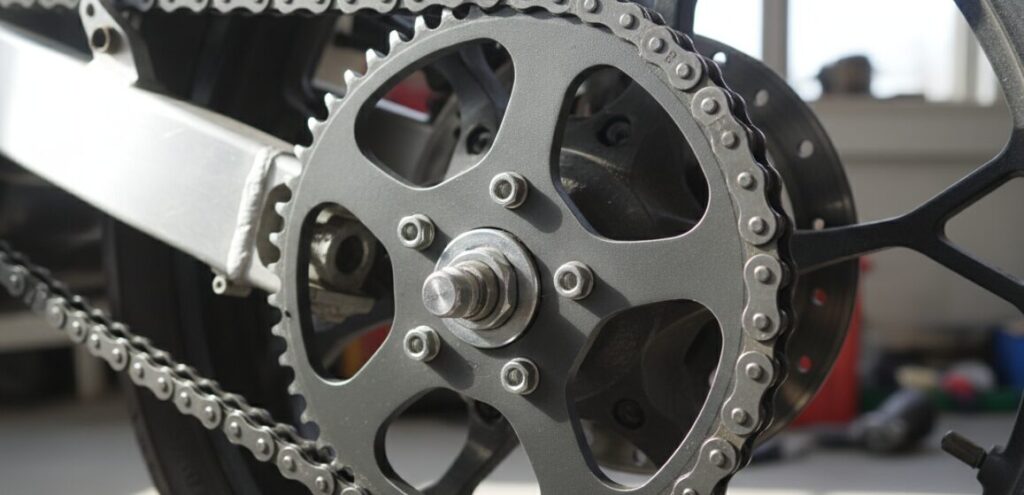
Increase the size (number of teeth) of the posterior tray.
Or reduce the size of the anterior tray.
When the gear ratio becomes larger (for example, from 3.0 to 3.2), the engine’s leverage on the rear wheels is stronger. This will make the “pulling feeling” more obvious when the car starts, the low-speed response is very sensitive, and the car will feel more energetic when riding. But this comes at a price: at high speeds, the engine speed (RPM) will remain high, which limits your top speed.
2. Smaller Gear Ratio: Optimize Speed
Conversely, a “smaller tooth ratio” is referred to as a “tall gearing”. You can adjust it in the following ways:
Reduce the size of the posterior tray.
Or increase the size of the anterior dental tray.
When the gear ratio is reduced (for example, from 3.0 to 2.8), the rear wheel rotates more times per revolutions of the engine than under the high gear ratio setting. This can effectively reduce the engine speed during cruising, and theoretically also increase the speed of the motorcycle. However, you have to be psychologically prepared. The torque at low speeds will be sacrificed. That is to say, when the traffic lights start, you will feel that the car has become “meat” and the acceleration is not so rapid.
Author:Arthur
With over a decade of riding and wrenching experience, I specialize in breaking down complex motorcycle mechanics. I’m passionate about helping riders understand how parts like sprockets impact their bike’s performance on the road.