Motomaxsfr


Search Product
How Often Should I Lube My Motorcycle Chain
As the 1 old technician who has crawled and rolled tens of thousands of kilometers in the motorcycle world, I know that the importance of the chain to the motorcycle is like the bones and muscles to the human body. It is directly related to your riding experience, vehicle performance, and even the most critical-your riding safety. So, “How often do motorcycle chains lubricate?” I have heard this question too many times.

My answer is by no means a simple number, but a “real kung fu” that combines actual combat experience and some “local methods”. Today, I will share with you without reservation what I have learned over the years. Don’t worry about the fancy theories, I’ll only tell you what really works.
Why Do I Care So Much To Lube Motorcycle Chain?
It’s all tears. When I was young, I also committed “lazy cancer”. I remember one time when I ran a long distance and didn’t take long with my new car, I thought to myself, how could the chain be so delicate? And the result? Just ran a few hundred kilometers, the chain began to “sing”, rustling, and then there is a sense of stagnation, riding that distressed ah.
When we arrived at the destination, we 1 checked that the chain was seriously worn and the toothed disc was broken. That repair, not only delayed the trip, but also severely let me out of blood. Not to mention spending money, the key is to affect the mood, the whole journey is not so perfect because of this episode.
Since then, I have been completely awakened, and chain lubrication has become a “compulsory course” before and after every ride “. Whether it is a short distance or a long distance, I will habitually check the condition of the chain and perform the necessary cleaning and lubrication. To tell the truth, this has really saved me a lot of trouble.
The life of the chain has been significantly prolonged, and the transmission efficiency is also higher. It is almost impossible to say how smooth it is to ride. Therefore, I often emphasize with the motorcycle friends around me that good chain maintenance can not only bring a more stable riding experience, but also ensure your driving safety, avoid detours and spend less money. Don’t feel troublesome, it’s responsible for your car and your safety.
How Often To Lube Motorcycle Chain?
When it comes to motorcycle chain lubrication, I am actually quite “axle”, because I know the importance of chain health to driving safety and vehicle life. So, I have my own set of “lubrication rhythms”, which you can say is a benchmark rule or a rule of thumb.

Datum rules:
I usually set every 500-700 kilometers as my “safety line”. What does this mean? That is, even if everything looks calm, I will check and lubricate the chain once around this mileage. This is like regular maintenance, prevention.
Of course, in addition to this benchmark, there are some specific scenarios that will immediately trigger my lubrication program:
- Rainy day after riding: As long as the motorcycle is wet in the rain, the first thing after returning home must be to clean and lubricate the chain. Rain water will not only wash away the lubricant, but also accelerate the chain rust, which is no joke. I never procrastinate, because I know that the longer I delay, the greater the potential damage.
- Off-road/muddy: I will deal with the chain immediately, even if it is only 1 a short muddy road, even if it looks fine. Sediment on the chain wear is huge, they are like small abrasive, can quickly destroy the chain structure. Clean up, re-lubrication, which is responsible for the performance of the car.
- Long-distance travel before/during: Before departure, the lubrication of the chain is a must. This ensures a good start to the journey. If the travel mileage exceeds 1000 kilometers, I will definitely find a chance to check and lubricate again on the way. After all, long-distance riding on the chain load is relatively large.
- Every car wash: motorcycle cleaning, water and detergent will more or less take away the lubricant on the chain. Therefore, after washing the car and waiting for the chain to dry, lubrication is a step that must be followed.
- The chain looks “dry”: the most intuitive judgment. If the chain lacks luster, the color is white, or even a little gray, it is clearly telling me: “Man, I need to be lubricated!” At this time, do not hesitate to act immediately.
- Rattle: If you start to hear a slight metal friction sound while riding, it means that the situation is a bit “late” and the chain may be on the verge of excessive wear. However, it is better to remedy it quickly than not to save it. Observe the situation after cleaning and lubricating.
My considerations (personal feelings and observations):
In addition to these explicit triggers, I consider a number of factors when determining the lubrication frequency:
- Road conditions: The chain is relatively less worn by urban commuting, because the frequency of start and stop is high and the speed is not too fast. But if it is often running mountain roads or long-term high-speed cruising, the chain will withstand greater stretch and friction, the wear speed will be faster, and the natural lubrication frequency will increase.
- Weather: If my area is dry and dusty, then the chain is more likely to be contaminated by sand and dust, and the lubrication frequency needs to be higher than that of wet areas. Although the wet environment is easy to rust, but the dust on the chain internal wear is more direct.
- Lubricant Type: Personally, I prefer chain oils with good permeability, strong adhesion and a certain cleaning ability. Some brands of lubricants do provide longer protection cycles, while others need to be replenished more frequently. I won’t specify a particular brand, but after years of use, you naturally develop your own preferences.
- Motorcycle type: The 1 heavy-duty rally truck I am currently riding. Its power output and vehicle weight determine that the chain can bear a greater load than a light street car. Therefore, the demand for chain oil and lubrication frequency of my rally car will definitely be higher than that of a 250cc street car.
- My “laziness” and “diligence”: to be honest, I am not so “perfect” every time “. Sometimes I’m lazy and think it’s okay to run another 100 or 200 kilometers. As a result, the chain really starts to protest, with abnormal noise or poor rotation. But more often, I choose to be diligent and spend a few more minutes cleaning and lubricating. The benefits are obvious: longer chain life, higher transmission efficiency, and smoother riding experience. The experience of replacing the chain in advance due to laziness really taught me a lesson.
My Chain Maintenance Operation Steps
Hello, everyone! Talk about motorcycle chain maintenance, various theories on the market. Today, I will not talk about those great principles. I will directly share with you that I have worked hard in the repair factory for so many years and summed up a set of “local methods”, which are simple and efficient, and the effect is really nothing to say.
Tool preparation:
We ‘ve got to get the guys ready. I always have a few here: a strong chain brush, which is used to clean dead corners. Cleaning agent I personally prefer Motul (Motul) C1 chain cleaner. It has good effect and is friendly to O-rings. If not, kerosene can make do with it, but the effect will be poor. I recommend Motul (Motul) C4 competitive chain oil for lubricating oil, which has strong adhesion and lasting lubrication. Finally, prepare a few clean piecesOld rags are indispensable for scrubbing and washing.

Cleaning:
Cleaning is the first and most critical step.
- Little trick: before spraying detergent, my habit is to use a dry rag to wipe the large pieces of sand and old oil on the chain roughly 1 times. Don’t underestimate this step, it can help you save a lot of detergent, but also make the follow-up cleaning more efficient.
- Cleaning points: after spraying detergent, scrub carefully with a chain brush. Remember, the focus is between the links and around the O-ring. These places are the easiest to hide dirt, but also the most affected chain life. Spend more time and clean up.
- Experience: I personally don’t recommend that some friends like to clean the chain with gasoline. Gasoline is relatively corrosive, and long-term use may cause damage to the O-ring (or X-ring) of the chain, causing them to harden or even crack, which is not worth the loss. Although the cost of professional chain cleaner is slightly higher, it protects the chain better and is a more cost-effective choice in the long run.

Drying:
After cleaning the chain, the next step is drying. I will use compressed air (if there is one in the repair shop) to dry the detergent and moisture on the chain. If there is no compressed air, let the chain dry naturally for a period of time to make sure it is completely dry. This is very important, if the chain is not dry on the lubricating oil, moisture will affect the adhesion and performance of the lubricating oil.

Lubrication:
After the chain is dry, it can be lubricated.
- Tip: I usually raise the rear wheel, turn the rear wheel a little bit, and at the same time spray oil evenly on the inside and above the chain. Why spray the inside above? Because the centrifugal force will throw the lubricating oil to the outside during the movement of the chain, spraying from the inside can ensure that the lubricating oil can better penetrate into the chain link.
- Dosage: One principle to remember: Don’t be greedy. A thin layer is enough to see a uniform luster on the surface of the chain. Spraying too much will only cause waste, and it will also throw the body everywhere, making it easier to absorb dust.
- Wait: After spraying the lubricating oil, I will let the chain stand for at least half an hour. This time is the key to allow the lubricant to fully penetrate the inside of the chain link and between the O-ring. Don’t worry about cycling, let the oil “eat” in.
- Wipe: In the last step, use a clean rag to wipe off the outer side of the chain. The purpose of this is to prevent the lubricating oil from being thrown everywhere during riding, soiling the wheel hub and rocker arm, and reducing the adhesion of dust. After wiping, the chain will look more refreshing, but the internal lubrication effect has been achieved.
Old Rider’s Advice: Don’t Step On These Pits!
lubrication is not equal to clean:
Many new motorcycle friends, even those who have been playing for a period of time, have a misunderstanding: just spray some lubricant if the chain is dirty. I tell you, this is no different from “painting on mud”. It is simply goring the lily! The sand and dust on the chain will become a kind of abrasive under the mixing of lubricants, which will accelerate the wear of the chain.
Therefore, the lubrication before must first clean! My own habit is that every time I come back from riding, if the road conditions are not good or I run a long distance, I must first thoroughly clean it 1 times with chain cleaning agent, and then lubricate it when it is dry.
How to choose a good motorcycle chain lube
Don’t just greet the chain with a bottle of oil or WD-40, that’s not the same thing. Chain oil is specially designed for motorcycle chains, with different viscosity and adhesion, and some also emphasize dustproof and waterproof.
For example, if you often run off-road, you may need stronger adhesion; if you run on the road, ordinary high-performance chain oil is enough. Personally, I prefer those transparent, quick-drying chain oils, which are not easy to throw everywhere and are convenient to observe the chain conditions. Remember, every kind of oil has its place, don’t mix it up and don’t make do with it.
How to check motorcycle chain loose symptoms
When lubricating, check the tightness of the chain. This is a small detail, but it is related to your riding safety. Too tight or too loose will cause problems. Too tight to increase the transmission resistance, wear fast, but also may damage the bearing; too loose is easy to off the chain, especially in the bumpy road. Usually, the chain should have a free stroke of 2-3cm in the middle position.
I usually press the chain with my finger to feel its elasticity. If you find that the tightness is wrong, adjust it quickly while lubricating, and don’t wait for the problem to regret it.
Concerned about chain life:
The chain is a consumable, one day to say “goodbye”. When should I change? First, look at the wear marks. Some chain discs have wear indicator points, grinding to that position means it is time to change. Second, listen to the voice. If the chain makes an abnormal metal friction sound or clicking sound when running, it is likely to be severely worn.
Furthermore, check the tightness adjustment limit. If you find that the chain has been adjusted to the tightest, but it is still loose soon, it means that the chain has been stretched too much and should be changed. Don’t expect it to “stick to it”, safety first.
Don’t “pretend” you can’t see the problem:
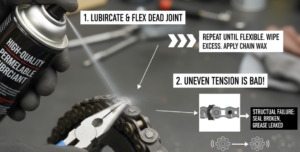
The maintenance of the chain is a long-term work. Sometimes, you may find rust spots on the chain, dead knots (chain links are stuck and inactive) or broken O-rings. I have seen many car friends, and when I saw these problems, I “pretended” not to see them and felt that I could still run. This is not responsible for yourself. Once these problems occur in the chain, it means that its strength and life have been greatly reduced. I usually knock a knot a few times to see if it can be recovered.
If not, then the chain should be changed. If you want to change it, don’t worry about the money. The cost of an accident is much more expensive than a new chain.
Related recommendations
-

How To Fix Tight Spot On Motorcycle Chain
291Fix Stuck Chain Links With Deep Cleaning Or Learn To Identify When A Tight Spot Means Your Chain Must Be Replaced.
View details -
Cost To Replace Motorcycle Chain
500What’s The Real Cost To Replace A Motorcycle Chain? See Price Breakdowns For Pro Service Vs. DIY Parts.
View details -
How Do I Rebuild A Brake Caliper
322Learn How To Rebuild A Brake Caliper Step-By-Step. Clean, Replace Seals, And Restore Your Braking Performance.
View details -
How To Install Master Link Motorcycle Chain
328Learn How To Install Master Link Motorcycle Chain Safely. Covers Greasing, Plate Pressing, And Ensuring Correct Clip Direction.
View details