 Motomaxsfr


Search Product
How Often To Clean And Lube Motorcycle Chain
For most street motorcycles, the “golden rule” for chain maintenance is usually: apply oil every 300 to 600 miles (about 500 to 1,000 kilometers) and perform a deep cleaning every 600 to 1,000 miles.
But to be honest, mileage is not the only criterion. If you are having fun in the rain, in the mud, or cycling on a coastal road with a high salt content, no matter how many kilometers you have run, you must clean and oil your bike immediately after returning. There’s no room for negotiation on this point.
The “Refuel & Lube” Rule
After replacing hundreds or even thousands of chains for customers in the repair shop, I was well aware that it was simply a fantasy to expect daily commuters to precisely record their mileage. This is too troublesome.
So I usually teach my students to use this more practical “gas station rule” :
- Regarding lubrication: Add oil every two or three times. After parking the car at home, spend two minutes spraying some oil on the chain. Remember, spray it when the chain is still hot right after running. At this time, the oil penetration effect is the best.
- Regarding cleaning: As long as you wash your car, you can also clean the chain at the same time.
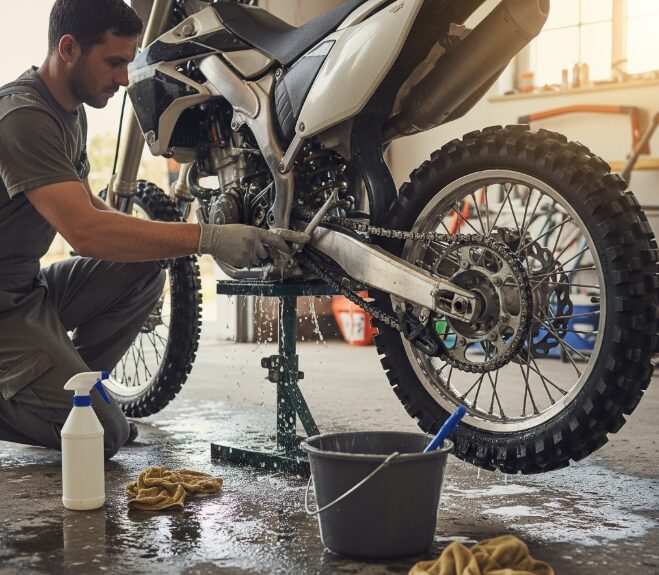
When to Lube Without Looking at the Odometer
Cars can talk. If you notice any of the following situations, it indicates that your chain is already “thirsty” :
- Metallic white light: Carefully examine the rollers of the chain (the rotating parts in the middle of the chain links). If they look dry and shiny rather than slightly black and oily, it indicates a lack of oil.
- Surface rust: If there is orange-red powder on the side plate, you are already too late. Hurry up and do a deep clean and apply oil.
- Kinked Links: If the chain does not straighten smoothly when leaving the chainring but gets stuck there like a ruler, it indicates that it is either stuck or rusty inside. This requires immediate deep cleaning. If it still can’t be saved, a new one will have to be replaced.
- The sound is incorrect: A well-lubricated chain makes a soft “whirring” sound. If what you hear is the “click” sound of metal hitting or a sharp squeaking sound, then it’s dry grinding.
Why be so meticulous
You should know that a decent set of chain chainrings now costs between 150 and 300 US dollars. Neglecting maintenance will directly cut the lifespan of your chain in half – it could have run 20,000 miles, but it might break down after 10,000 miles.
Scenario-Based Maintenance
If you are a long-distance motorcycle travel enthusiast or an all-weather rider, the “300-mile rule” is merely a passing line. Based on my experience, for different scenarios, you need to adjust the maintenance plan in this way:
1. Rain Rider
Rainwater not only washes away the lubricating oil but also brings the sand and gravel from the road surface into the O-rings of the chain.
My suggestion: Whenever you encounter heavy rain, you must oil the chain immediately once it dries, even if you have only ridden 50 miles today. Water, steel and oxygen can produce a pile of rust for you after just one night.

2. Dusty or sandy environment
If you ride an ADV off-road or through construction sites, the lubricating oil might instead become a vacuum cleaner. When oil and sand are mixed, they turn into a powerful “grinding paste” that quickly eats up your dental tray.
My suggestion: In this case, cleaning must be done first. Never spray oil directly on the mud. Be sure to use chain cleaner and a brush to remove the sand and gravel before applying oil. Under such road conditions, I would recommend using “dry” wax-based chain oil, which is less likely to accumulate dust.
3. Winter vehicle lockdown
Before pushing the car into the garage for the winter, thoroughly clean the chain and spray a thick layer of oil on it. This layer of oil can act as a barrier to block moisture and condensation water, preventing the chain from rusting during parking.
Do oil-sealed chains need frequent lubrication?
Often, fellow cyclists ask me, “Mike, my chain is an oil-sealed chain. Isn’t it sealed with grease inside?” Still need to be oiled frequently?
The answer is affirmative.
Although the grease inside the pin shaft is sealed, you need lubrication for two other key reasons:
- Protective sealing ring: If the rubber ring cracks, the grease sealed by the original factory will be lost and the chain will be ruined. External lubrication can keep rubber moist.
- Buffering chainring contact: There is a solid metal hard contact between the chain rollers and the chainring teeth. Lubricating oil serves as a buffer layer here.
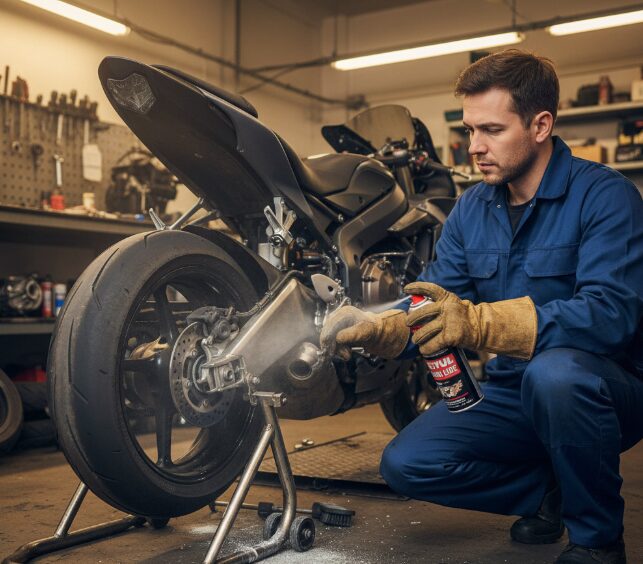
A Mechanic’s Safety Warning
Never, never clean or lubricate the chain when the engine is running and in gear.
This is no joke. I’ve seen too many cyclists try to wipe the chain while the wheels are turning to save that little time, and as a result, they cut off their fingers.
Frame the vehicle on a large support or a lifting frame and turn the wheels by hand. Spend an extra 30 seconds to save your finger. It’s worth it no matter how you calculate it.
About the Author: Mike Thompson
I’m Mike Thompson, a certified motorcycle technician with over 11 years of experience turning wrenches in professional dealerships. But I’m not just the guy behind the service counter; I’m a rider just like you, with over 100,000 miles on the odometer. I know that factory manuals don’t always account for real-world rain and grit. That’s why I write guides that combine strict mechanical standards with practical, road-tested advice—helping you spend less time in the garage and more time on the road.