 Motomaxsfr


Search Product
Motorcycle Chain Dimensions interpretation and measurement
First of all, I have compiled a standard table of motorcycle chain sizes here. This table is very practical when I help fellow riders choose chains in the store. Everyone can quickly compare the size they need.
| Chain model | Pitch (P) (inches) | Pitch (mm) | Roller diameter (d1) (mm) (maximum) | Inner wide (b1) (minimum) | Typical application scenario |
| 415 | 1/2 “ | 12.70mm | 7.77mm | 4.76mm (3/16″) | Mopeds, small 50cc |
| 420 | 1/2 “ | 12.70mm | 7.77mm | 6.35mm (1/4″) | Off-road vehicle, 80cc-125cc |
| 428 | 1/2 “ | 12.70mm | 8.51mm | 7.75mm (5/16″) | 125cc-250cc street bike |
| 520 | 5/8 “ | 15.875mm | 10.16mm | 6.35mm (1/4″) | Off-road vehicle, 250cc-600cc |
| 525 | 5/8 “ | 15.875mm | 10.16mm | 7.95mm (5/16″) | 600cc-900cc street bike |
| 530 | 5/8 “ | 15.875mm | 10.16mm | 9.53mm (3/8″) | 1000cc+ Superbike |
| 532 | 5/8 “ | 15.875mm | 11.10mm | 9.53mm (3/8″) | Old-fashioned heavy-duty sports station wagon |
| 630 | 3/4 “ | 19.05mm | 11.91mm | 9.53mm (3/8″) | Old-fashioned high-power motorcycle |
Note: “Pitch” refers to the distance between the centers of the pins. “Inner width” refers to the space on the inner side of the chain that accommodates the teeth of the gear disc.
Part 1: Decoding the Numbers
Next, I’ll explain to you all what the numbers in these chain models mean and how to read them professionally.
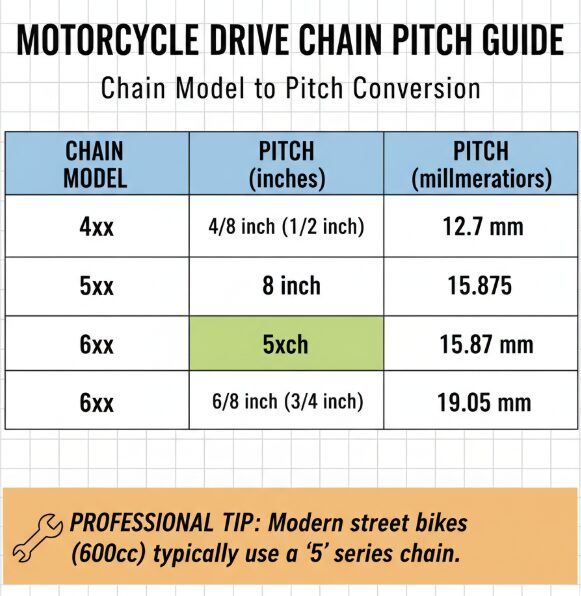
The First Digit: The Pitch
The first number of the chain model represents the pitch of the chain, that is, the distance between the center points of the two pins. This value is calculated in one-eighth of an inch (1/8).
- “4xx” indicates that the pitch is 4/8 inches, which is equivalent to 1/2 inch, or 12.7 millimeters.
- “5xx” is 5/8 inches, which is 15.875 millimeters.
- “6xx” is 6/8 inches, that is, 3/4 inches, which equals 19.05 millimeters.
My professional tip: Based on my years of experience in repairing motorcycles, if your motorcycle is a modern street bike with a displacement ranging from 600cc to 1000cc, you can almost be sure that what you see is a “5” series chain.
The Last Two Digits: The Width
The last two digits of the model number tell you the inner width of the chain, that is, the gap between the inner chain plates and the tooth part of the gear disc that needs to go in.
- “x20” indicates that the inner width is 2.0 one-eighth inches (1/4 inch).
- “x25” indicates that the inner width is 2.5 one-eighth inches (5/16 inches).
- “x30” indicates that the inner width is 3.0 one-eighth inches (3/8 inches).
So, what exactly are the differences between 520, 525 and 530 chains? In fact, the lengths (pitches) between their pins are exactly the same, but the inner widths are different.
- 520 is the narrowest (and also the lightest).
- 530 is the widest (and usually the sturdiest and heaviest).
Special reminder: You must never force the chain of 530 onto the gear disk of 520, nor vice versa. Either the chain can’t be put on at all, or it’s too loose, swaying left and right when running. It will wear out your chainring in less than 500 miles. Therefore, the size of the chain must match that of the sprocket. This is the most fundamental rule.
Part 2: How to Measure Your Chain
In the store, I have come across many motorcycles with chains so old that they are smeared with oil mud and the model stamps are hard to read. If you encounter this situation too, don’t panic. Grab a vernier caliper (if you really don’t have one, a reliable steel ruler will do), and follow me in these two steps.
Step 1: Measure the Pitch
Measure the distance from the center of one pin to the center of the next pin.
- If it is approximately 12.7 millimeters (0.5 inches), then it is a 4-series chain.
- If it is approximately 15.9 millimeters (0.625 inches), then it is a 5 series chain.
Step 2: Measure the Inside Width
Measure the gap between the two inner chain plates (the rollers are placed in this gap).
- The measured value is 6.35 millimeters. That’s the 520 chain.
- The measured value is 7.95 millimeters. That’s the 525 chain.
- The measured value is 9.53 millimeters. That’s the 530 chain.
Workshop tip: Never measure the “outer width” of the chain (the distance from the outer chain plate to the outer chain plate). This size may vary depending on the brand, the thickness of the steel, and whether it is an O-ring or an X-ring chain, so it has little reference value.
520 Chain Conversions Performance Durability and Dimensions
When it comes to the modification of 520 chains, many cyclists are quite interested. So let’s talk about the technical tricks involved.
Why do the 520 modification?
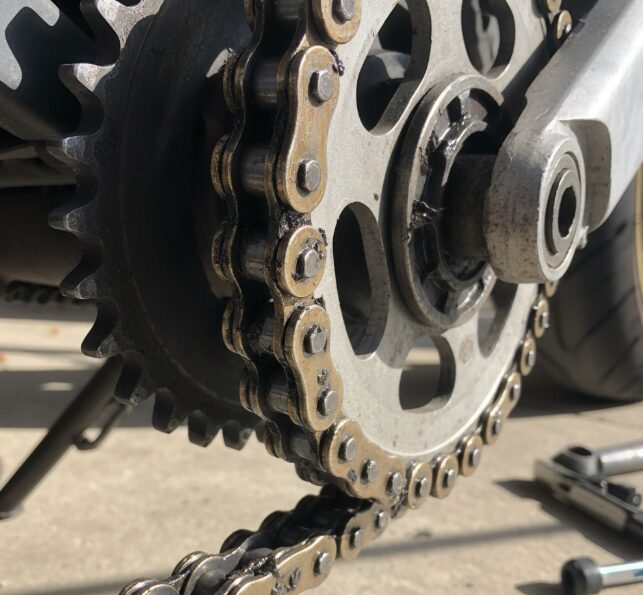
For instance, a 1000cc superbike often comes with a relatively heavy 530 chain from the factory. If it is replaced with a 520 chain (of course, the gear disk should also be replaced with a 520 one), the most direct benefit is that it can reduce the unsprung rotational mass.
- Benefits: Faster acceleration and more sensitive suspension response.
- Disadvantage: There will be some sacrifice in durability. After all, the contact area of the 520 chain is smaller than that of the 530, so its ability to distribute loads will definitely be weaker.
The relationship between tensile strength and size
Many people thought that 530 chains must be more “sturdy” than 520 chains. This might have been true fifteen years ago, but now with the development of metal material technology, the situation has changed. A high-end, competition-grade 520 chain can have a tensile strength of over 9,000 pounds, which is even stronger than some cheap original 530 chains.
However, tensile strength is not the criterion for measuring everything. The width of the 530 chain is larger, which can distribute the load more evenly to the contact surface between the teeth of the gear disc and the rollers. This means that even if the ultimate breaking strength of the two chains is the same, the 530 chain is almost always more durable in terms of mileage than the 520 chain. This is because the advantage of width is reflected in the load distribution.
Pin shaft length and clearance (O-ring vs. X-ring)
If you are building a custom motorcycle, especially those that want wide tires, you need to carefully consider the length of the chain pins. Although the inner width of the chain is standardized (for example, the inner width of 530 is always 3/8 inches), the overall width of the chain varies greatly.
- Standard chainless: The narrowest.
- O-ring chain: It will be wider (because of the rubber sealing ring).
- X-type link chain: Usually slightly narrower than O-type link, but still wider than standard acyclic chain.
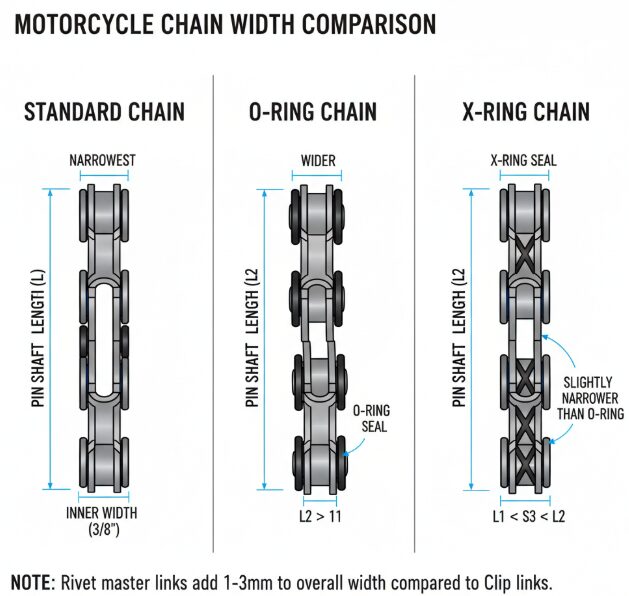
If the gap between your chain and the frame or tire is very tight, you must carefully check the “pin shaft length” parameter provided by the manufacturer. In addition, Rivet master links are usually slightly wider than Clip links. This difference of 1-3 millimeters needs to be taken into account in some extreme modifications.
About the Author: Mark Reynolds
I’m Mark Reynolds, the Technical Director at Apex Moto Works. With over 15 years of grease-under-the-fingernails experience in the shop, I’ve replaced thousands of drivetrains on everything from vintage commuters to track-spec superbikes. I write these guides to translate complex service manual data into plain English, helping you skip the guesswork, buy the right parts, and wrench with confidence.