Motomaxsfr


Search Product
Motorcycle Chain Size Chart: The Complete Guide
Written By:Russell Mitchell
Russell Mitchell is the founder and lead designer of Exile Cycles, a world-renowned custom motorcycle company based in California. Known for his distinctive industrial and minimalist design style, he has built a reputation as one of the most influential custom bike builders of his generation. With appearances on television shows such as Discovery Channel’s Biker Build-Off, Mitchell has inspired riders and builders worldwide. His hands-on expertise in engineering, fabrication, and design continues to shape modern custom motorcycle culture.
In the transmission system of a motorcycle, the chain is very important. It silently transmits the power of the engine to the rear wheels. If the chain size is wrong, it will not only affect the riding experience, but also bring safety hazards. Many riders are often confused by the numbers of 420, 428, 520, 525 and 530 when buying or replacing chains. In fact, the model of the chain is regular, understand the “pitch” and “width” of the two key parameters, you can easily get the selection. This article will provide you with the complete Motorcycle Chain Size Chart, combined with practical skills, to take you to quickly master how to judge and choose the most suitable chain.
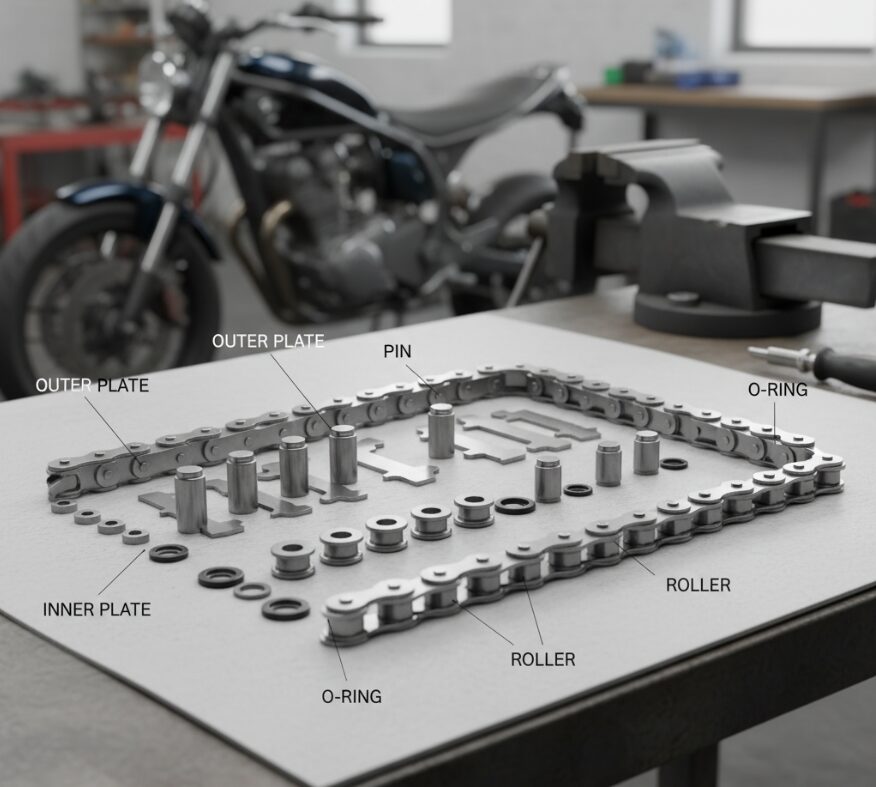
Basic Knowledge of Motorcycle Chain:
A. Composition of the chain:
Let’s take a look at what the chain is made.
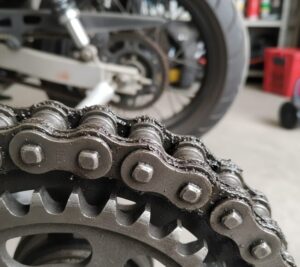
- Outer Plate: It is the outer two plates that connect the entire chain.
- Inner Plate: Inside the chain, between the pin and the sleeve.
- Pin: This is the core of the chain, connecting the inner and outer links and bearing the pulling force.
- Bushing: sleeved on the outside of the pin shaft, and the inner chain link together to form a hinge point, the roller is sleeved on the outside of it.
- Roller: This is the part that directly contacts our tooth plate and flywheel, and is responsible for transmitting power. The degree of wear directly affects the transmission efficiency.
B. Interpretation of the meaning of the chain model
The first number represents the “pitch” of the chain “. It is the center distance between two adjacent pins on the chain.
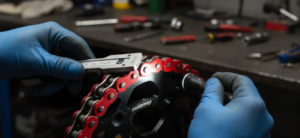
The measurement is very simple, just take a caliper and measure it.
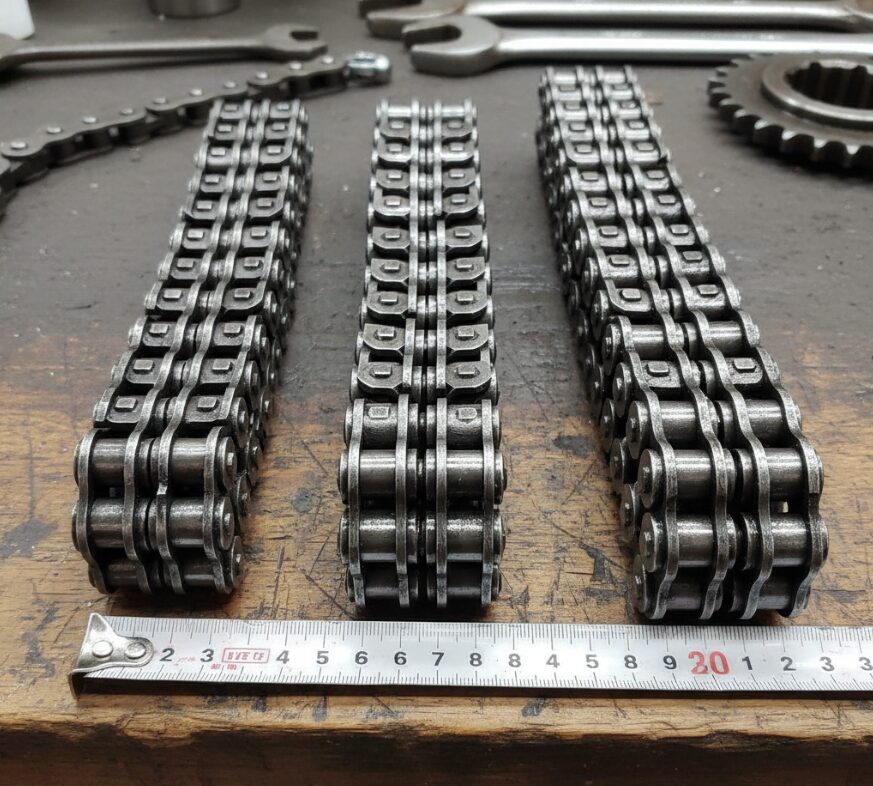
- 4 series (1/2 inch): This is the most common, such as 420 and 428. 1/2 inch is about 12.7mm.
- 5 series (5/8 inch): stout than 4 series, like 520, 525 and 530. 5/8 inch is 15.875mm.
- 6 series (3/4 inch): This is even rarer. It is generally used on heavy motorcycles. 3/4 inch is 19.05mm.
Important reminder! Different pitch of the chain, absolutely can not be mixed! Your 4-series chain cannot be installed on the 5-series dental tray, and vice versa.
The last two numbers represent the width of the chain, specifically, the distance between the inner link plates.
Measurement method: measure the gap between the inner chain plates.
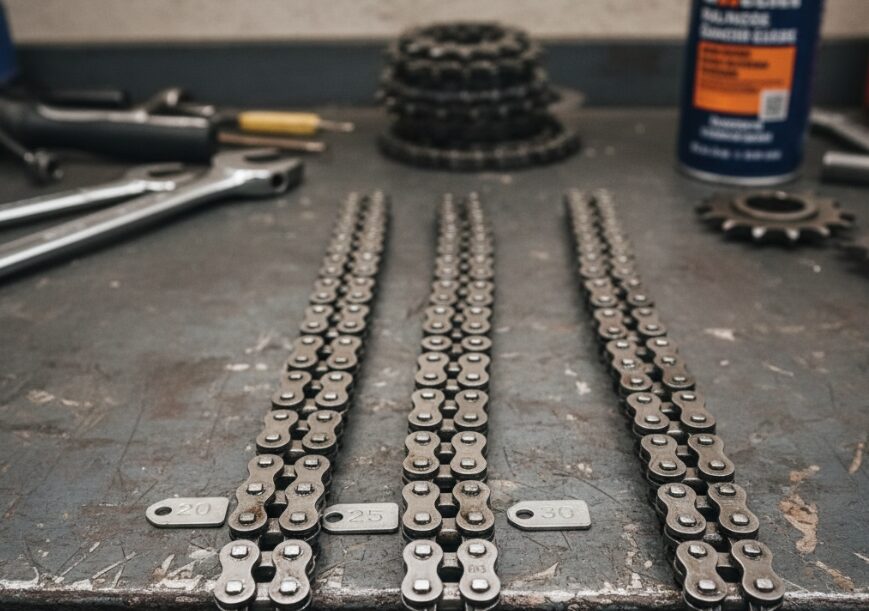
- 20: For example, 520, this “20” represents the width, usually 6.35mm.
- 25: such as 525, the width is about 7.94mm.
- 30: such as 530, the width is about 9.53mm.
Simply put, the wider the chain, the greater the torque it can withstand, which usually means that the chain is stronger and more durable. For motorcycles with large displacement and high torque, a wider chain must be used. Otherwise,once oil is supplied, the chain may “jump teeth” or break directly. That is no joke.
These seals are not decoration, their role can be big:
- Lubrication retention: The sealing ring locks the grease between the pin and the sleeve to avoid loss.
- Prevent dust from entering: isolate external dust and sand to reduce wear and tear.
- Extended life: Because of maintaining good lubrication and cleaning, the life of the chain is naturally long.
If you’re still unsure about the meaning of the numbers ‘520 / 525 / 530’, how to measure them, or how to choose a chain, we recommend reading our main article, “Motorcycle Chain Sizes Dimensions Explained,” where we provide a more systematic explanation and comparison.
Common oil seal types are:


- O-Ring: the most basic type of oil seal, the section is circular.
- X-Ring: The cross-section is X-shaped. The sealing effect is better than the O-ring and the friction is smaller.
- Z-Ring: There is also a ZVM-X called Ring, which is a more advanced oil seal type with better performance.
Of course, although the oil seal chain has a long life and worry-free maintenance, the price is also more expensive than the chain without oil seal. Non-sealed Chain now basically only has some small displacement or retro cars in use, requiring frequent lubrication and cleaning.
Motorcycle Chain Size Chart:
We often say that the chain size, mainly look at two data: pitch and internal width. These two determine whether the chain can perfectly fit your tooth plate and tooth plate. The following table hopes to help you understand at a glance:
| Chain model | Pitch | Internal Width | Applicable displacement/model examples | Strength/Characteristics |
| 420 | 1/2″ (12.7mm) | 1/4″ (6.35mm) | Lightweight off-road vehicles, small-displacement street bikes (less than 125cc) | Relatively light and has average strength,Suitable for models with low power output. |
| 428 | 1/2″ (12.7mm) | 5/16″ (7.94mm) | 125-250cc street bikes, some off-road bikes | This “panacea” in small-displacement cars balances strength and weight and is very common. |
| 520 | 5/8″ (15.875mm) | 1/4″ (6.35mm) | Medium to large displacement street bikes, sports cars, and off-road vehicles (250-750cc) | Performance-oriented, taking into account both lightness and strength, it is the first choice for many sports motorcycles. |
| 525 | 5/8″ (15.875mm) | 5/16″ (7.94mm) | Large-displacement street bikes and touring bikes (750-1000cc) | Based on the 520, it has enhanced strength and better durability, making it suitable for models that require higher reliability. |
| 530 | 5/8″ (15.875mm) | 3/8″ (9.525mm) | Top-of-the-line sports cars, heavy cruisers (over 1000cc) | It has the highest strength and durability, but also the heaviest weight, and is mainly used in high-horsepower and high-torque models. |
| 630 | 3/4″ (19.05mm) | 3/8″ (9.525mm) | Very few old heavy motorcycles and custom cars | It is relatively rare now and is mainly used for some particularly heavy or old vehicles with special needs. |
From this table, you can see intuitively that the larger the number, the stronger the chain and the greater the power it can withstand. For example, from 420 to 530, although the pitch changes somewhat, the increase in internal width is a more obvious trend, which is directly related to the transverse strength and wear resistance of the chain.
Motorcycle Chain Sizes Dimensions: How to Determine?
Check out the user manual: This is the most official and accurate source. What chain your car was leaving the factory is clearly written in the manual.
Check the mark on the old chain or dental plate: Many chain outer plates, or on the front and rear dental plates, will have a steel seal or lettering indicating the chain model, such as “DID 525V”.
Official website search: If the above two methods are inconvenient, you can go to the official website of the motorcycle brand or the professional motorcycle accessories website, enter your model information, and you can usually find the matching chain size.
Choosing the right chain size is the basis for ensuring driving safety and vehicle performance.
Motorcycle chains seem inconspicuous, but they are key components to ensure vehicle performance and safety. By understanding the meaning behind the chain model and referring to the Motorcycle Chain Size Chart provided in this article, you can be more confident in choosing the right chain for your car. Whether it is a lightweight street car or a large displacement heavy machine, the right chain can not only extend the life, but also improve the smoothness and reliability of riding.
Remember: when replacing the chain, first consult the user manual, and then refer to the old chain or tooth plate mark to ensure that it is foolproof. Choose the right chain to make every ride feel at ease and carefree!
Frequently Asked Questions
how long does a motorcycle chain last?
The life of the motorcycle chain depends on usage habits, chain type and maintenance. General oil sealless chains have a service life of about 10,000-20,000 km, while oil seal chains with O-Ring, X-Ring can have a life of 30,000-50,000 km. If you ride at high speeds frequently, accelerate violently, or lack maintenance for long periods of time, your lifespan will be greatly reduced.
How Often to Lube Motorcycle Chain?
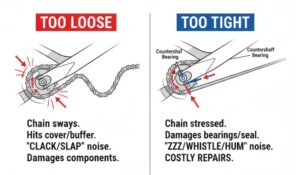
Under normal conditions, it is recommended to lubricate the chain every 500-800 km. If you regularly ride in rainy, muddy or dusty road conditions, it’s best to get on the oil more often, say once every 300-500 km. While oiling, you can check the chain tension by the way to avoid too loose or too tight.
What To Use To Clean Motorcycle Chain?
When cleaning the chain, it is best to use a special chain cleaner, which can remove the sludge without damaging the oil seal. If not, you can also use kerosene instead, but it is not recommended to use gasoline or strong solvents, because they may corrode the chain oil seal. After cleaning, remember to brush with a chain brush, dry thoroughly, and then re-oiled.
Related recommendations
-

Front Sprocket Noise Motorcycle
418Fix Front Sprocket Noise On Your Motorcycle. Diagnose Clicking Or Grinding Caused By Tension, Worn Teeth, Or Alignment.
View details -
What Size Sprocket Is Best For Top Speed
76Master Motorcycle Sprocket Tuning For Top Speed. Learn The Golden Rule And Balance Power Vs. Drag.
View details -
Do You Need A Chain Guard On A Motorcycle
223Do You Need A Chain Guard? No, But You Risk Grease Fling, Injury, And Fines. See Why A Custom Guard Is The Safer Choice.
View details -
How Long Do Motorcycle Chains Last
372Learn How Long Motorcycle Chains Last And Essential Tips For Extending The Life Of Your Motorcycle Chain And Sprockets.
View details