
 Motomaxsfr


Search Product
Motorcycle Chain Sizes Dimensions: The Ultimate Guide
Wriiten By: Author Biography
Erv Kanemoto is a legendary American motorcycle mechanic and racing team owner renowned for his technical mastery and decades of experience in motorsports. Over the years, he has tuned and maintained championship-winning bikes and worked closely with top riders in national and international motorcycle racing circuits. His precise craftsmanship, deep mechanical insight, and competitive track record have earned him a revered status in the motorcycle community.
In the transmission system of motorcycle, the chain is one of the most easily overlooked, but the most critical components. A suitable chain can not only improve the power transmission efficiency, but also greatly extend the life of the vehicle. However, when faced with models such as 520, 525, 530, etc., many riders are often confused-what do these numbers represent? How do they affect your motorcycle performance and riding experience?
In this ultimate guide to Motorcycle Chain Sizes Dimensions, we will start from the basic principles and analyze in detail the naming rules of chain dimensions, the measurement methods of pitch and roller width, the advantages and disadvantages of different types of chains, and how to choose the most suitable for your car model The chain. Whether you are a daily commuter rider, off-road enthusiast, or track fanatic, after reading this guide, you will be able to confidently judge which motorcycle chain best suits your needs.
Motorcycle Chain Sizes Dimensions basics:
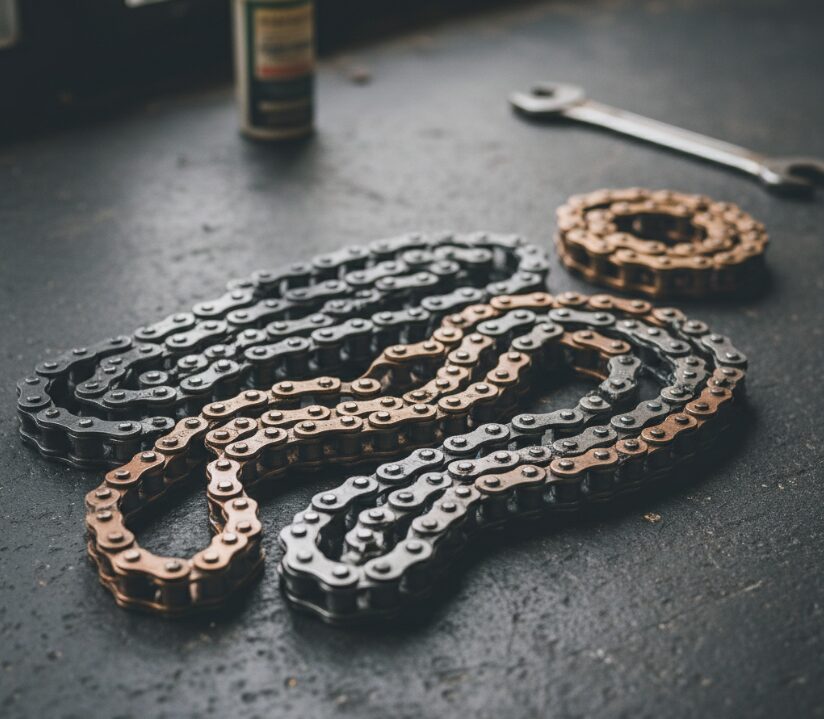
Let’s start with the naming rules of the chain. When you see “520”, “525” or “530” written on the chain package, these numbers are not written casually, they represent the key size information of the chain.
Analysis of Chain Size Naming Rules
The first number (Pitch): This number represents the pitch of the chain, that is, the distance between the center points of the two chain pins. However, there is a small “trap” here, this number is not a direct millimeter number. For example, the pitch of the “5” series chain is 5/8 inch, which is 15.875mm. Pitch is a key factor that affects the strength of the chain and its matching with the toothed disc. The greater the pitch, the greater the strength of the chain, but it also increases the weight. On the contrary, the pitch is small, the chain is lighter, suitable for the pursuit of lightweight models.
The last two digits (Roller Width): These two digits represent the width of the roller in the chain. Again, this is not a direct millimeter. For example, “20” represents a roller width of 1/4 inch (6.35 mm), “25” represents 5/16 inch (7.94 mm), and “30” represents 3/8 inch (9.52 mm). The roller width must perfectly match the thickness of the toothed disc, otherwise it will cause uneven wear and even the chain to fall off. So, when replacing the chain, it is very important to ensure that the roller width is consistent with the original vehicle.
“H”, “HV”, “XW” and other suffixes: These letter suffixes represent the type and enhancement characteristics of the chain.
“H” (Heavy Duty): Represents heavy-duty chains, usually with thicker plates and higher strength, suitable for large-displacement or high-load models.
“HV” (High Performance V-Ring): This is unique to some brands and usually represents a high-performance oil seal chain.
“XW” (Extra Wide): Not all brands have it, but it usually implies a wider roller or stronger structure.
There are also products like “GXW” and “ZVM-X”, which are actually the names of major brands on their respective high-performance oil seal chains, basically pointing to stronger durability and lower friction.
Different chain types and their characteristics
Now let’s talk about the “sealing” technology of the chain, which directly affects the life and maintenance cycle of the chain.
- O-Ring:
- Advantages: good sealing, can effectively prevent dust and moisture from entering the chain pin, keep the grease, thereby significantly extending the life of the chain. For daily commuting and long-distance travel, O-ring chains are a cost-effective choice.
- Disadvantages: The oil seal ring will produce a certain amount of friction, making the transmission efficiency slightly lower than the chain without oil seal, but for most street cars, this difference is almost negligible.
- X-Ring:
- Advantages: The design of the X-ring is more advanced than the O-ring, and its contact area is smaller, so the friction is lower and the transmission efficiency is higher. At the same time, due to its unique sealing structure, the heat dissipation is better, and the grease retention ability is stronger, which means a longer service life.
- Disadvantages: The cost is usually higher than the O-ring chain. If your budget allows, the X-ring chain is definitely an upgrade worth investing in.
- Z-Ring: This is the latest oil seal chain technology. It further optimizes the sealing and friction properties on the basis of the X-ring, which theoretically provides longer life and lower losses. However, there are relatively few options on the market and the prices are the highest.
- Chain without oil seal:
- Advantages: the most lightweight, the smallest friction, the highest transmission efficiency. For motorcycles for track use, this is the first choice, because the power output of every 1 watts is crucial.
- Disadvantages: short life, need to be cleaned and lubricated very frequently, and basically need maintenance after every ride. If you are not a professional racer, or do not have the time and energy to maintain frequently, I personally do not recommend choosing an oil-free chain.
Motorcycle common chain size
- Street Bikes: Most medium displacement street cars (e. g. CB650R, Z900) usually use 520 or 525 chains. The 520 chain is light and has high transmission efficiency, suitable for sports street cars; while the 525 chain provides better strength and durability, suitable for daily riding and some travel purposes. For public upgraded super street cars (such as Z1000 and MT-10), for the sake of power, many will choose 530 chains to ensure strength and reliability.
- Off-road/Adventure Bikes: Off-road vehicles require high chain strength and impact resistance, while also taking into account lightweight. Most off-road vehicles will use 520 chains, but H-type or reinforced chains will be selected. Rally cars (such as Africa Twin, GS series) will choose 525 or 530 chains according to displacement and design load to cope with complex road conditions and long-distance riding needs.
- Race Bikes: Racing cars pursue extreme lightweight and transmission efficiency, so most racing cars will use 520 unsealed chains. Of course, for top-level events like MotoGP or WSBK, they will have more professional chain suppliers and customized solutions, which are not in the scope of our discussion.
| Chain model | Pitch | Roller Width | Applicable displacement/model examples | Strength/Characteristics |
| 420 | 1/2″ (12.7mm) | 1/4″ (6.35mm) | Lightweight off-road vehicles, small-displacement street bikes (less than 125cc) | Relatively light and has average strength,Suitable for models with low power output. |
| 428 | 1/2″ (12.7mm) | 5/16″ (7.94mm) | 125-250cc street bikes, some off-road bikes | This “panacea” in small-displacement cars balances strength and weight and is very common. |
| 520 | 5/8″ (15.875mm) | 1/4″ (6.35mm) | Medium to large displacement street bikes, sports cars, and off-road vehicles (250-750cc) | Performance-oriented, taking into account both lightness and strength, it is the first choice for many sports motorcycles. |
| 525 | 5/8″ (15.875mm) | 5/16″ (7.94mm) | Large-displacement street bikes and touring bikes (750-1000cc) | Based on the 520, it has enhanced strength and better durability, making it suitable for models that require higher reliability. |
| 530 | 5/8″ (15.875mm) | 3/8″ (9.525mm) | Top-of-the-line sports cars, heavy cruisers (over 1000cc) | It has the highest strength and durability, but also the heaviest weight, and is mainly used in high-horsepower and high-torque models. |
| 630 | 3/4″ (19.05mm) | 3/8″ (9.525mm) | Very few old heavy motorcycles and custom cars | It is relatively rare now and is mainly used for some particularly heavy or old vehicles with special needs. |
How to accurately measure your Motorcycle Chain Sizes Dimensions
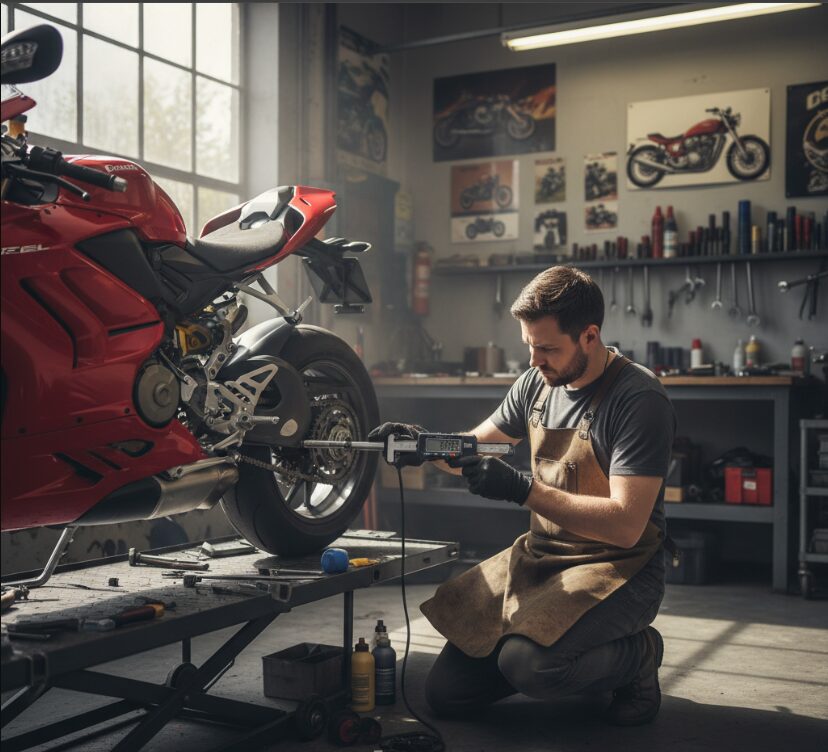
In our industry, the most important thing is the word “accurate. Measure the chain size, too. You need to prepare some handy tools and then follow the steps step by step.
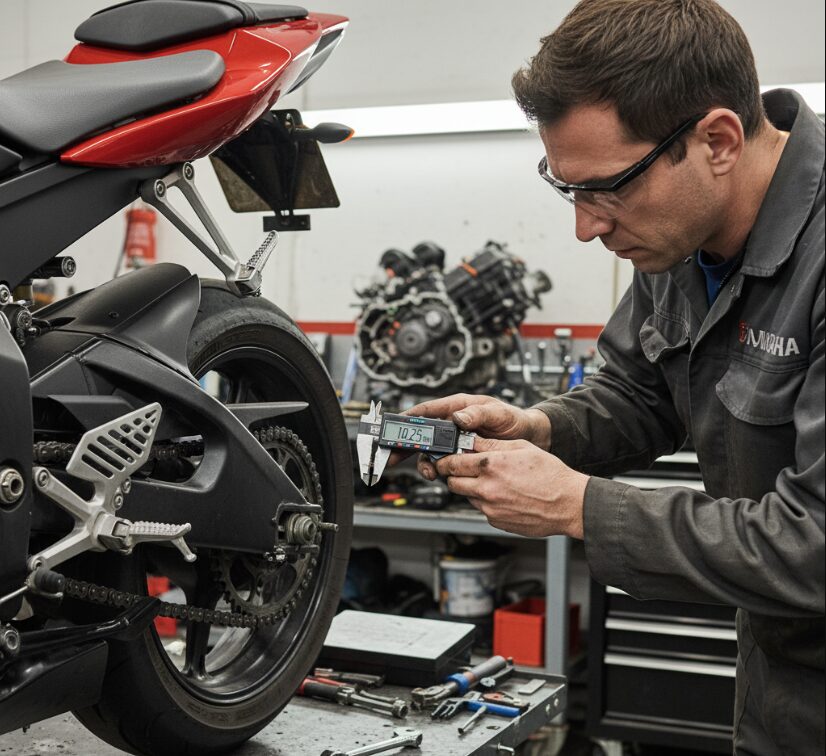
Measuring tools:
- Vernier caliper: This is a sharp tool for precision measurement, which can help you with pitch and inner width.
- Steel tape or chain measuring ruler: mainly used to measure the total length of the chain, or calculate the number of chain links. A chain measuring ruler would be more convenient, but a tape measure would do the same.
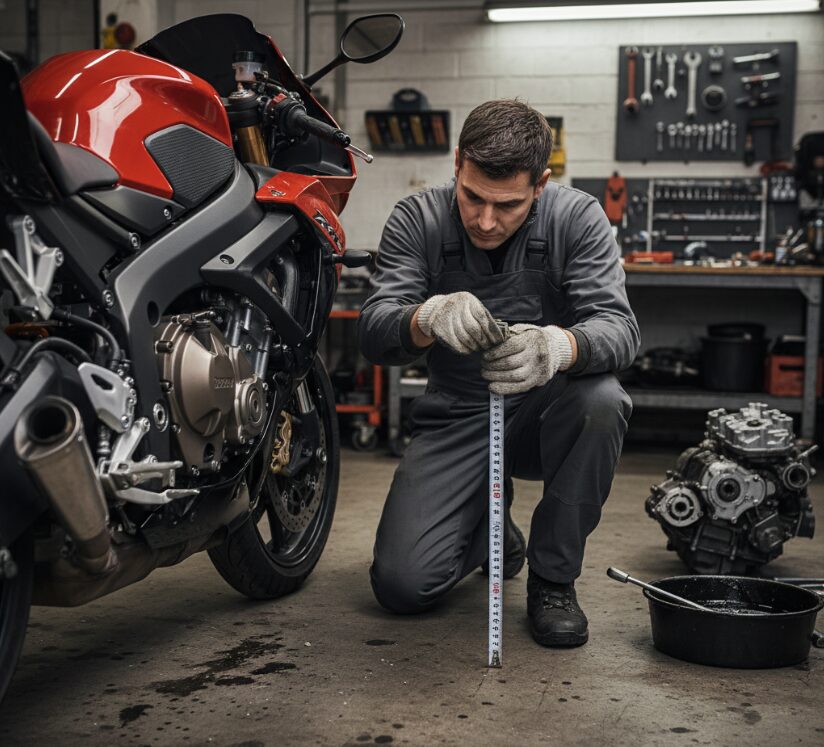
Measurement steps:
- Pitch: Pitch is the distance between the centers of two adjacent pins on the chain. This is one of the most critical parameters in the chain size.
- Operation: Find a flat table and spread the chain flat. Take out your vernier caliper and align the two measuring jaws of the caliper with the center points of the two adjacent pins. Remember, be sure to aim at the center, so as to be accurate. Gently clamp and read the value on the caliper. To be more accurate, you can measure several groups and take an average to avoid a single measurement error. For example, a common 428 chain has a pitch of 12.7mm (1/2 inch).
- Measure the Roller Width: The roller width refers to the distance between the chain rollers, that is, the width between the two roller chain plates on the inner side of the chain. This size determines whether the chain can perfectly match your tooth plate and flywheel.
- Operation: still use vernier caliper. Insert the inner measuring claw of the caliper between the two rollers of the chain and clamp the inner link plate. Read the numeric value. Similarly, measure several more places to ensure accuracy. If the inner width is too narrow, the chain may not be installed smoothly or easily stuck; if it is too wide, it may cause the chain to shake and increase wear.
- Measuring chain length (number of links): The length of the chain is usually determined by calculating the number of links instead of directly measuring the total length with a meter ruler. A link includes an inner link plate and an outer link plate.
- Operation: This is relatively simple and rough. You can tile the chain and count from the beginning. When counting, you can find a colored marker and mark every 1 section, or count one pin as a starting point and count to another pin. The least error-prone method is to count the number of all the outer or inner link plates, and then multiply by 2. Or, the most intuitive way is to find a rivet first, and then count the number of rivets from the beginning to the last rivet. Because the length of the chain directly affects the tightness of the chain, too long or too short need to be adjusted, otherwise it will affect the transmission efficiency, and may even cause the chain to fall off.
Motorcycle Chain Sizes Dimensions compatibility with motorcycle models
First and foremost, the chain size must be perfectly compatible with your motorcycle model.
The Importance of Original Chain
I often emphasize with everyone that when you get a new car or are about to replace the chain, the first thing is to open your motorcycle user manual. The specifications of the original chain are clearly written in it, including chain model, number of links, etc. Don’t feel trouble, this is the most authoritative and accurate source of information. The original chain is strictly tested by engineers to ensure the best match with your engine power, frame structure, transmission ratio and other aspects. If you are not sure about the information in the manual, or the manual cannot be found, you can consult some reliable online parts catalogs and enter your model information to find it.
Consideration when upgrading or replacing
Of course, sometimes we may not be satisfied with the original factory, or the original chain life needs to be replaced. At this time, in addition to the original specifications, we also need to consider several factors:
- Displacement and horsepower: This is an important indicator of the strength of the chain. Can a 125cc commuter car and a 1000cc public upgrade sports car have the same requirements for tensile strength and fatigue resistance of the chain? Obviously not. The greater the displacement and horsepower, the higher the requirements for the chain. You need to choose a stronger and more durable chain. For example, public upgrade models usually require 525 or 530 types of chains, while 520 may be sufficient for small displacement.
- Riding style: Your riding style will also affect the choice of chain. If you are the kind of sports car driver who often accelerates violently and brakes suddenly, or likes to play off-road, the impact of the chain will be greater, so you need to choose a chain with higher performance and more emphasis on durability. However, if it is Buddhist commuting and daily transportation, then some economical but quality chains are enough.
- Gear matching: this point I must emphasize! The chain size must match the front and rear toothed discs exactly! If you change the chain but not the toothed disc, or change the toothed disc but not the chain, resulting in a size discrepancy, the consequences are disastrous. If it is light, it will accelerate wear, and if it is heavy, it will be off-chain, or even jam the wheels. This is fatal at high speeds. For example, if you use a 520 chain, the front and rear chainrings must also be of 520 specifications.
Compatibility Query Tool
In order to facilitate everyone to find, now online there are many useful chain compatibility query tool or website. For example, some large parts sales sites, or brand official website, usually have their own query system. You only need to enter your motorcycle brand, model and year, and it can help you filter out compatible chain models, number of links and even recommended chainplates. This is very convenient, save a lot of the trouble of access to information.
Understanding the Motorcycle Chain Sizes Dimensions is not just an accumulation of technical knowledge, but the key to ensuring safety and performance stability while riding. By correctly selecting, installing and maintaining the chain, you can make the power output smoother, reduce mechanical losses, and even improve the handling of the entire vehicle. If you are planning to replace the chain, be sure to refer to the original factory specifications to ensure a perfect match with the gear disc; if you want to upgrade the performance, you can choose the appropriate model and oil seal type according to the displacement and riding style.
A quality and matching chain, the “lifeblood” of your car. Hopefully this “Motorcycle Chain Sizes Dimensions: The Ultimate Guide” will be your definitive reference on the road to motorcycle maintenance, escorting you every ride.