 Motomaxsfr


Search Product
Motorcycle Chain Specifications: Size & Best Chain
Motorcycle chain specification analysis.
What are the different specifications for motorcycle chains?
To be honest, the chains all look the same, but in fact they are very different. If you know these specifications clearly, you will know how to choose the one that suits you best.
Chain Size
This is the most basic and important information. You will see numbers like “520”, “525”, “530.
The first number represents the pitch of the chain, that is, the distance between the center of the chain link, which is usually a multiple of 1/8 inch. For example, “5” means 5/8 inch.
The last two numbers indicate the inner width of the chain, which is also a multiple of 1/8 inch.
Simply put, the larger the number, the stronger the chain and usually the greater the force.
Common Dimensions and Applications
- 420/428: Common in scooters, off-road vehicles, mopeds and entry-level models.
- 520: One of the most common sizes, suitable for middleweight sports motorcycles and many large-displacement models. Both strength and lightweight.
- 525: Suitable for large-displacement motorcycles, stronger than 520 and providing higher tensile strength.
- 530: Suitable for very large displacement motorcycles and some cruising vehicles, providing the highest strength and durability.
- 630: Less common, usually used for old-fashioned large-displacement heavy-duty motorcycles.
Chain Type
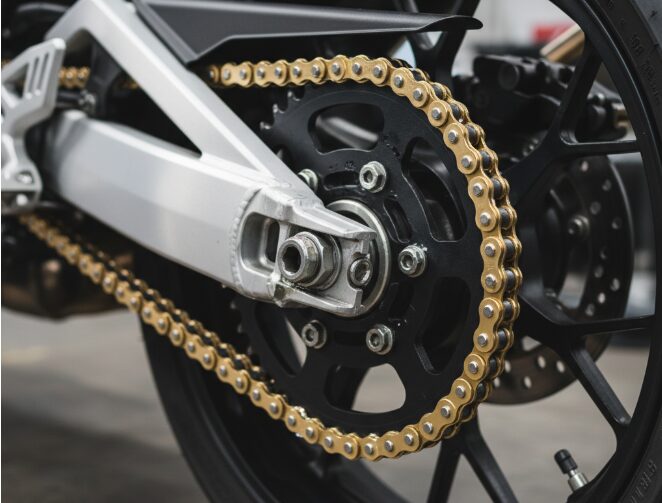
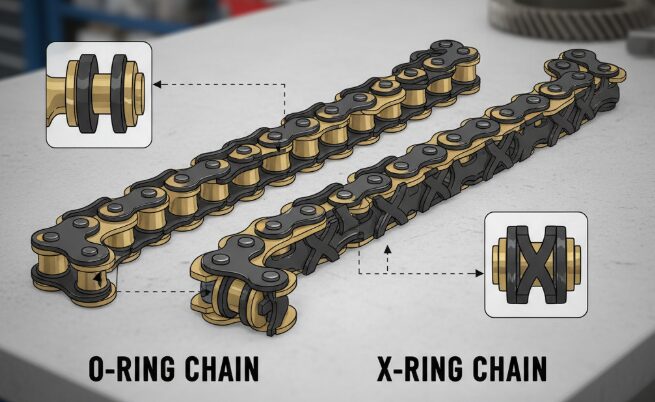
In addition to size, the type of chain is also a key. The most common ones on the market are O-chain and X-chain.
O-Ring chain: This is a more traditional 1 type. There is an O-shaped rubber ring between the roller and the chain plate for sealing to lock the grease and prevent dust from entering. Stable performance, the price is relatively close to the people.
X-Ring Chain: The shape of the sealing ring of the X-chain is more complicated and is X-shaped. This design can provide a larger contact area and stronger sealing, reduce friction, extend chain life, and higher transmission efficiency. Of course, the price will be slightly higher. In my opinion, if you are looking for better performance and longer service life, the X-chain is definitely worth considering.
Number of Chain Links
The number of links in the chain is how many links there are in the whole chain. This length is determined according to the specific model of your motorcycle and the length of the rear rocker arm. When replacing the chain, it is usually necessary to keep the same number of links with the original chain.
If you want to change the chain, but don’t know what to change? Here are some practical suggestions.
How to choose the right chain for your motorcycle?
Think About Your Riding Environment and Style!
Different riding methods and road conditions affect your choice of chain specifications
Urban Commuting and Everyday
In this case, the riding speed is not high, and stop-and-go is the norm in the urban area. You have a low probability of extreme performance requirements. What needs to be considered more is whether durability and maintenance are worry-free.
Recommended Chain Size and Type:
Small Displacement (125cc-300cc): For these cars, such as your 125cc commuter small pedal, or 300cc entry-level sports car, usually 428 or 520 the chain is just right. Think about it, the car itself is light, the load of the engine is not large, and the running resistance of the chain is naturally low. There’s no need to fit them with that ‘tube’ chain, that’s a waste. You only need a high-quality 428 or 520 chain. As long as you are diligent, clean and lubricate, it can definitely maximize its performance without any problems.
Medium displacement (300cc-650cc): If you are riding a 300cc to 650cc street car or station wagon, then my experience is that 525 chain is a very reliable choice. It’s like finding the perfect balance of strength and durability. Therefore, many original cars are directly equipped with 525 chains, which are all considered and reasonable.
In this environment, the sealing performance of the O-Ring chain is enough to cope with, and the price is more people-friendly. Regular cleaning and lubrication, it can also have a long life.
Long Distance Travel and Leisure Riding
when you plan to run long distances, from sudden rainstorms to dusty country roads, the reliability and durability of the chain becomes crucial.
For your medium and large displacement (600cc-1000cc) ADV, station wagon, or those large displacement street cars, 525 or 530 chains are almost standard in the industry. Personally, I suggest that if the car is heavy or you plan to run long distances, I prefer to recommend 530.
In this riding environment, the X-ring chain is almost an unnecessary choice. Can keep mud and dust out. This stuff can greatly extend the life of the chain, but also save you a lot of maintenance trouble.
Performance Driving and Track Competition
High speed, frequent throttle opening and closing, and the kind of violent braking will make the chain withstand unprecedented tests. We pursue lightweight, maximum transmission efficiency and tensile strength.
In many competitive situations, especially in large-displacement cars, you will often see the designation of narrower 520 chains.
The idea here is to reduce the unsprung mass and minimize the drag of the transmission system. However, they are built with more advanced materials and sophisticated manufacturing processes to provide higher tensile strength.
Of course, for some large-displacement racing cars, especially those with huge torque or those who want more durability while pursuing performance, a high-strength 525 chain can also be considered.
In this application, you must use a high-performance X-ring chain. All changes are to reduce friction, improve strength, and maintain a seal.
Cross Country and Forest Road
Mud, sand, wading, frequent shocks and jumps. It needs to withstand huge pulling forces and has to constantly fight against external pollutants.
For light off-road vehicles (125cc-300cc), 428 or 520 chains are generally used.
If you upgrade to a larger displacement off-road vehicle or ADV model, the 520 or 525 chain becomes the first choice. They can provide the necessary impact resistance to cope with more rugged terrain and higher power output.
In this environment, you can only choose the X-ring chain. The excellent sealing performance of the X-ring is to protect the internal grease from sand and water intrusion. This is the best way to prevent premature wear and chain failure in harsh conditions.

Combine Your Manual!
First things first, that owner’s manual isn’t just taking up space in your toolkit – it’s your primary guide. It tells you exactly what chain size your specific motorcycle model was designed for. If it says 525, then that’s what you stick with.
Some of you might be thinking, “Hey, maybe a 525 isn’t enough for the way I ride. Can I just slap a 530 on there?” And yeah, in some cases, you can swing it. You absolutely, positively must confirm that bigger chain will play nice with your existing sprockets. And even more critical, you need to be sure there’s enough clearance everywhere – around the chain itself, the frame, the swingarm, and any other bits and bobs in that rear end. Trust me, I’ve seen too many riders try to force a square peg into a round hole, and it always ends up being a bigger headache and a lighter wallet.
Before you even think about changing chain sizes, swing by a reputable motorcycle shop and talk to a pro, or spend some serious quality time with that owner’s manual. Don’t learn the hard way, let someone with experience guide you.
I hope that after reading this article, you can understand more clearly the specifications of motorcycle chains and how to choose the right chain for your car. Although the chain is the most basic component, it is directly related to your riding safety and overall experience. So, choose the right chain, can really enjoy the fun of riding!