 Motomaxsfr



Поиск продукта
How Many Miles Does A Motorcycle Chain Last
There is no absolute fixed value for the question of how many miles a motorcycle chain can run. But if we look at the “nominal value” of big data, a well-maintained O-ring or X-ring sealing chain can usually support 15,000 to 30,000 miles. On the other hand, the lower-cost unsealed chains have a high probability of reaching their life limits at 5,000 to 10,000 miles.
The big difference depends on several key variables: continuous cleaning, lubrication, tension adjustment, alignment accuracy, and your driving environment (dirt and rain are definitely equipment life killers). Moreover, I must emphasize that the chain and tooth plate must be replaced in complete sets, otherwise the reliability of the whole system will be greatly reduced.
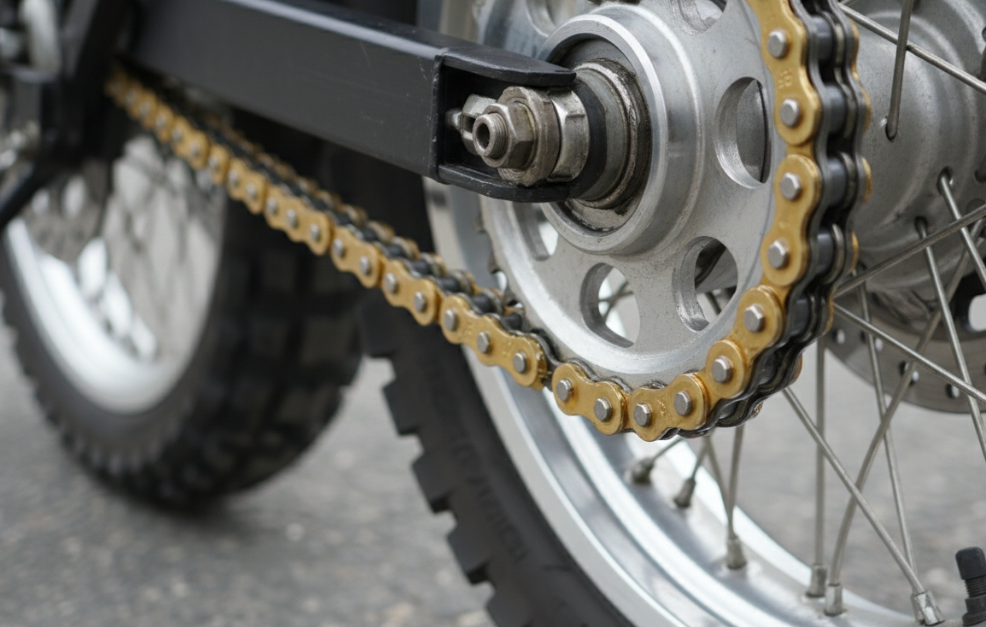
Technical Differences In Chain Type
When we’re talking about mileage, the biggest variable is actually what kind of chain you have in your car. It’s like choosing a capacitor in a power supply design, where the specification determines the upper limit.
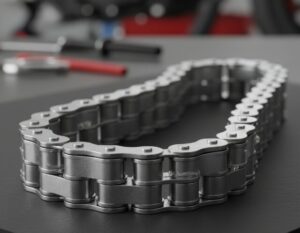
Sealed Chains-O-ring & X-ring: This is the industry standard for modern street motorcycles. They use a rubber seal ring placed between the inner plate and the outer plate, the factory grease “seal” in the pin shaft and the inside of the roller, while the dirt is blocked outside. Thanks to this internal self-lubricating mechanism, high-quality sealed chains usually have the highest mileage performance, easily reaching 15,000 to 30,000 miles with normal maintenance.
Non-Sealed Chains: Standard non-sealing chains do not have these protective rubber rings. Although they have low frictional resistance and low procurement costs, the subsequent maintenance costs are extremely high. Because there is no seal ring to lock the lubricant, direct metal-to-metal wear occurs very quickly, typically limiting its life to 5,000 to 10,000 miles. This is not necessarily cost-effective in terms of total life cycle cost (TCO).
Key Maintenance Elements
In order to maximize the life of this “transmission component”, you must pay attention to the three pillars of maintenance:
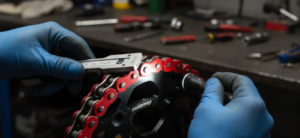
Cleaning and Lubrication: The dirt, gravel and old ointment on the road mix together, in essence, a strong abrasive, will continue to erode the metal. Continuous cleaning and relubrication (ideally every 300-600 miles) can wash away these pollutants and prevent the steel from oxidizing and rusting.
Correct tension: If the chain is too tight, it will put huge stress on the engine output shaft and the chain itself, causing it to stretch or even break quickly. If it is too loose, the chain will swing, which can hit and damage the rocker arm or cone. It needs a balance.
Tray alignment: If the rear wheels are not perfectly aligned, the crankset will pull the chain from the side instead of being forced in a straight line. This “side load” causes rapid and uneven wear of the link plates and the cutters.
Driving Conditions And Environment
Your operating environment plays a decisive role in life. The aforementioned reference value of 15,000 to 30,000 miles is based on the assumption that you have a paved road and good weather.
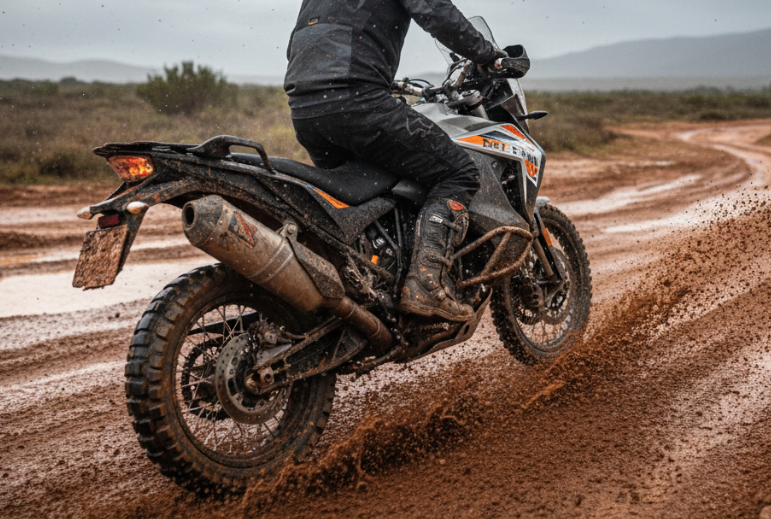
Harsh conditions: Riding in mud, mud or sand will introduce abrasive particles, which will penetrate into the inside of the chain roller. Similarly, frequent riding in the rain can wash away external lubricants and incur rust. Under these conditions, the life curve will fall off the cliff.
Driving style: Violent acceleration and Wheelies will apply sudden, high-load impact stress to the chain, causing it to stretch faster than a smooth commuter ride. High-power motorcycles inherently accelerate chain wear due to the huge torque transmitted to the rear wheels.
Why Must The Chain And The Tooth Plate Be Replaced In Complete Sets
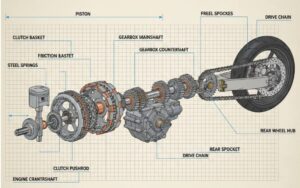
As the chain stretches, it wears the teeth of the cutters to accommodate their lengthened pitch. If you put a brand new chain on an old, worn-out tooth plate, the mismatched pitch will destroy the new chain in a very short time. To ensure the best system fit and to reach that 30,000 mile target, always replace the chain, anterior and posterior trays as a complete kit.
Identify The Replacement Signal
No matter what the number on the odometer is, it is necessary to check the transmission system regularly. Replace immediately if:
Excessive stretching: If you have adjusted the regulator to the maximum limit, but the chain is still loose, it means that it has been completely scrapped.
Замороженные ссылки: If the links are stiff, kinked, or cannot be easily straightened by hand, the internal lubrication has failed and the metal has begun to bite.
Disc wear: Observe the teeth of the disc. If they look like hooks, sharp or pointed tips (like shark teeth) instead of flat tops, then the entire system needs to be replaced.
Corrosion and damage: Deep corrosion, roller cracking or missing O-rings are clear physical indicators that the chain is no longer safe.
Author: Mark
As a dedicated rider and mechanic for over 11 years, I’ve seen firsthand how maintenance impacts performance. I write practical guides to help you extend the life of your bike’s essential parts, like your chain and sprockets.
Предыдущий: Can A Loose Motorcycle Chain Cause Vibration
Похожие рекомендации
-

Как работают мотоциклетные звездочки
243Поймите, как работают мотоциклетные звездочки. Узнайте, как передаточные числа передают мощность, чтобы сбалансировать крутящий момент и максимальную скорость.
Посмотреть детали -
Как измерить слабину цепи мотоцикла
232Узнайте, как измерить слабину цепи мотоцикла за считанные минуты. Убедитесь, что ваш мотоцикл работает безопасно и безупречно.
Посмотреть детали -
Do You Need A Chain Guard On A Motorcycle
45Do You Need A Chain Guard? No, But You Risk Grease Fling, Injury, And Fines. See Why A Custom Guard Is The Safer Choice.
Посмотреть детали -
Тип мотоциклетной цепи Объяснение
209Объяснение различий между стандартными, кольцевыми и х-кольцевыми цепями для мотоциклов.
Посмотреть детали