
 Motomaxsfr


Search Product
What Are Motorcycle Sprockets
Motorcycle sprockets are toothed wheels that transfer engine power from the transmission to the rear wheel via a chain. Acting as the core of the final drive system, they typically consist of a smaller front sprocket (countershaft) and a larger rear sprocket. By changing the size of these sprockets, riders can alter the gearing ratio to function as a “torque amplifier,” customizing the bike’s performance to favor either explosive acceleration or higher top speed.
The Role Of Sprocket In The Final Drive System
To really understand what a motorcycle sprocket is, it depends on its position in the mechanical structure of the vehicle. As mentioned earlier, it is the key link between the engine output and the actual rotation of the wheels. The whole process starts with the gearbox, where the power of the engine is pooled. The sprocket transfers the energy of this rotation to the rear wheel abruptly by snapping into the metal links of the chain. Without these toothed wheels, the engine would just spin and the car wouldn’t move at all. I often describe them as “hands” that hold the chain tightly. Only through these two hands can the power really fall to the ground.
Distinguish Between Two Key Components
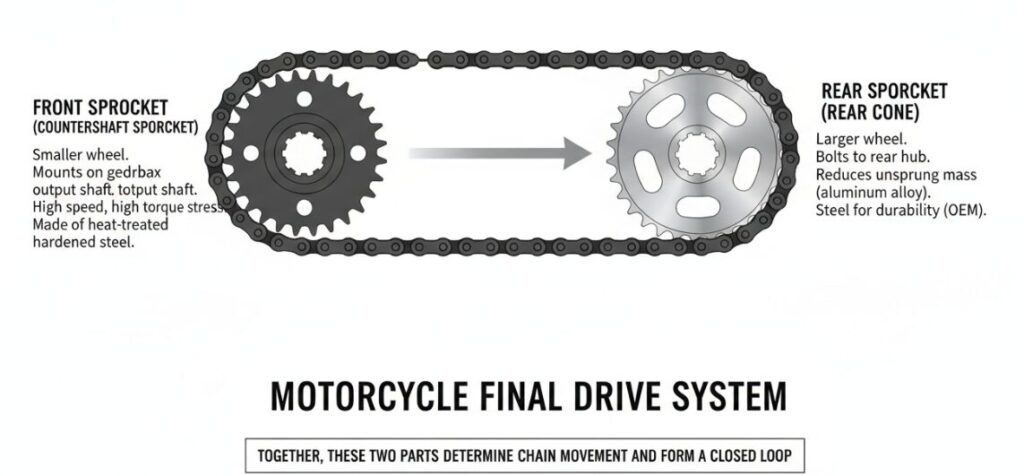
The sprocket system is never alone, but the cooperation of two parts, each of which has its particularity:
Front gear (countershaft sprocket): This is the smaller wheel that is mounted directly on the output shaft of the gearbox. Because it has a very high speed and has to withstand the first wave of direct torque from the engine, the pressure is very high. So you will find that this piece is usually made of heat-treated hardened steel, otherwise it will not be able to withstand this high stress.
Rear Cone: This large wheel is bolted to the rear hub. Generally, the original factory uses steel for durability, but many performance-seeking car owners I have come into contact with, especially those who play on the track, will change to aluminum alloy in order to reduce the unsprung quality.
These two parts together determine how the chain runs and form a closed loop. This is what we often call the final drive of motorcycles .
How The Sprocket Acts As A “Torque Amplifier”
The term “torque amplifier” actually describes the mechanical advantage produced by the interaction between the front and back teeth, which depends entirely on the gear ratio. The tooth ratio algorithm is simple: divide the number of teeth of the previous dental disc by the number of teeth of the posterior disc. For example, if your back disc has 45 teeth and the front disc has 15 teeth, the ratio is 3:1. This means that the front tooth plate has to turn three full turns and the rear wheel has to turn turn. This deceleration effect physically amplifies the torque transmitted by the engine to the ground, making it easier for the car to start from a standstill.
The Trade-Off Between Acceleration And Extreme Speed
Many riders come to me not only to replace worn parts, but also to refit and adjust the character of the car according to the riding style. Changing the number of teeth is actually making a trade-off:
Explosiveness (acceleration): If you want the car to be more powerful, we will do a “gear down” . Simply put, it is a smaller front plate or a larger rear plate. In this way, the gear ratio becomes larger and the torque on the wheel increases. The result is that the starting moment is very fierce. This setting is especially useful in urban commuting, stunt or cross-country forest roads.
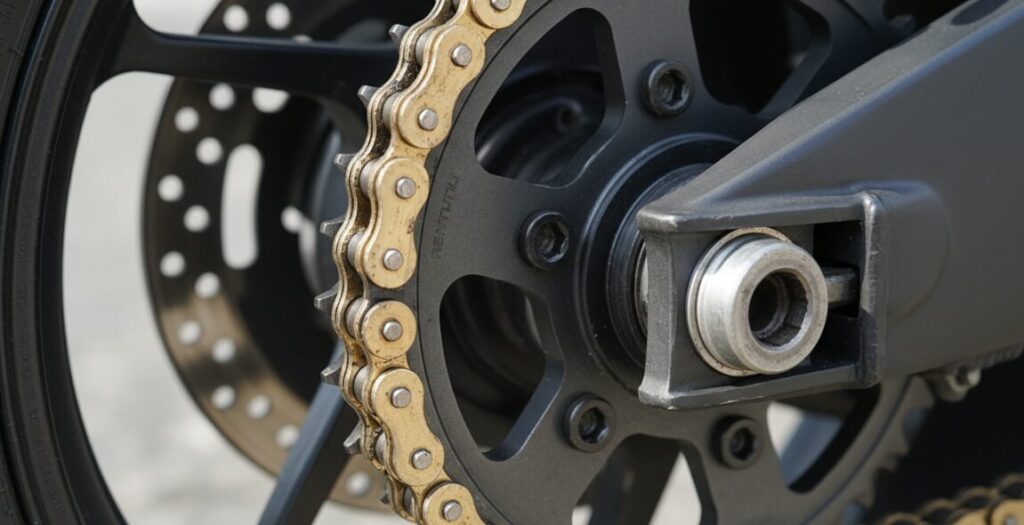
Higher speed: Conversely, if you want to run faster, you have to choose a larger front set or a smaller back set. This reduces the gear ratio. Although you will feel that the car is a bit “fleshy” when you start, it is not as fast as before, but when you run at high speed, the engine speed will be lower and the speed extension will be better. This is generally the first choice for high-speed cruising or large straight tracks.
Author:Jay
Hi, I’m a motorcycle mechanics enthusiast with over a decade of experience in the garage. I specialize in optimizing final drive systems to get the most out of every engine. I’ve spent countless hours testing different gearing ratios—swapping out front and rear sprockets to find that perfect balance between explosive acceleration and highway cruising speed.