Motomaxsfr


Search Product
What Happens If Your Motorcycle Chain Is Too Loose
A loose chain is not just a small negligence in maintenance, it is a hidden danger that seriously threatens life and safety, which will directly destroy your motorcycle and even endanger your safety.
If your motorcycle chain is too loose, the first thing you notice is that the throttle response becomes particularly “thief”, with an obvious sense of frustration, accompanied by the noise of metal impact-that is, the drive chain is beating the rocker arm or frame. From the mechanical structure, the chain is too loose will lead to uneven metal stretching, and force the sprocket to appear prematurely “hook” or jump teeth phenomenon, resulting in serious power loss.
The most extreme situations are often the most deadly: the chain may completely “derail”, that is, fall off the rear sprocket. At this time, the chain will either pump forward with huge inertia and penetrate the engine housing, causing the oil to drain instantly and the engine to be completely scrapped; or it will get stuck between the wheel and the rocker arm, causing the rear wheel to lock instantly. In order to save your life, you must ensure that the chain tension is maintained within the range specified in the manual.
Intuitive Warning
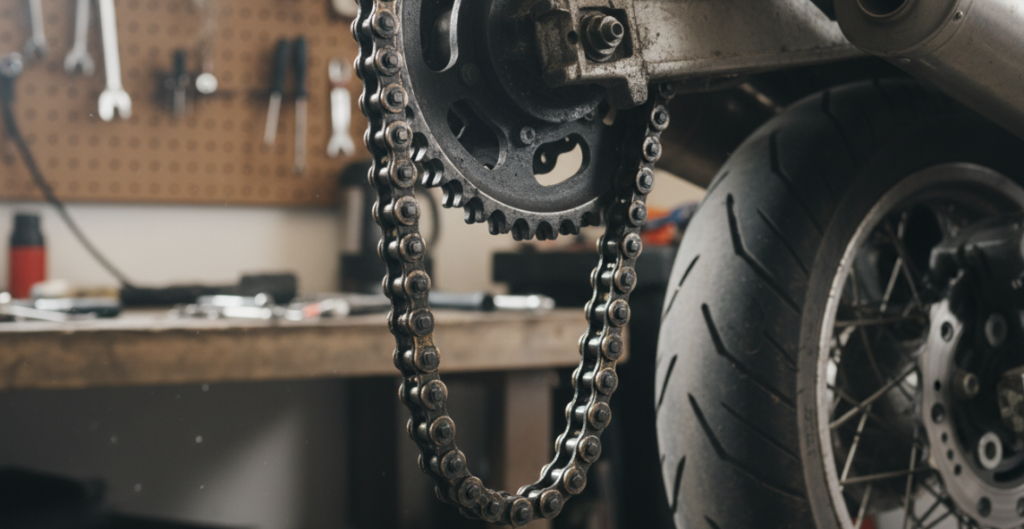
When the chain tightness exceeds the recommended value, you will first lose that smooth power output. Because the “open amount” in the transmission system is too large, there will be a delay between when you unscrew the throttle and when the rear wheels start to exert force. When the chain is finally tightened, it will exert a force, causing the whole motorcycle to rush forward.
You will hear unique metal collision sound, which is “chain beating”. Because the chain swings up and down too much, it will hit the rocker arm or chain guard. This is not just a noise problem, it will physically scratch the rocker arm, even wear through the protective slider, and ultimately damage the structural integrity of the frame.
Mechanical Damage
A loose chain cannot fit exactly into the sprocket tooth slot. Under normal circumstances, the chain rollers should fall deep and evenly into the recesses between the teeth, but loose chains tend to climb towards the tips of the teeth. This creates an uneven pressure with the following consequences:
Sprocket hooking: The sprocket teeth begin to bend forward, forming a shape like a hook. Once this wear occurs, the sprocket is completely useless, and it will quickly wear out any new chains you replace.
Tooth skipping: During severe acceleration, the chain may slide directly over the sprocket teeth. This produces severe vibrations and results in severe power loss because the engine’s energy is not effectively transmitted to the ground.
Uneven stretching: the chain is constantly beating and bouncing under load, which will lead to uneven stress on each link and pin shaft, resulting in “tight points” and “loose points”, so that you can’t adjust the tension correctly in the future.
Worst Case Scenario
The most horrible consequence of a loose chain is derailment. When the chain is too loose, its physical oscillation may be severe enough to make it jump out of the rear sprocket completely. If this happens while driving, there are usually two catastrophic consequences:
Engine housing perforation: the inertia of the engine will continue to drive the front sprocket to rotate. The derailed chain will pump forward with great force, hitting the thin engine housing. The shell directly broke a hole and high-pressure oil gushed out, causing the engine to lock up instantly and even causing a fire.
The rear wheel is locked: The other is that the chain is accumulated and stuck between the rear sprocket and the rocker arm. This has the effect of a sudden brake, and the rear wheel will lock up instantly. At high speeds, the rear wheel lock almost means inevitable loss of control and motorcycle crash.
How To Prevent Problems Before They Occur
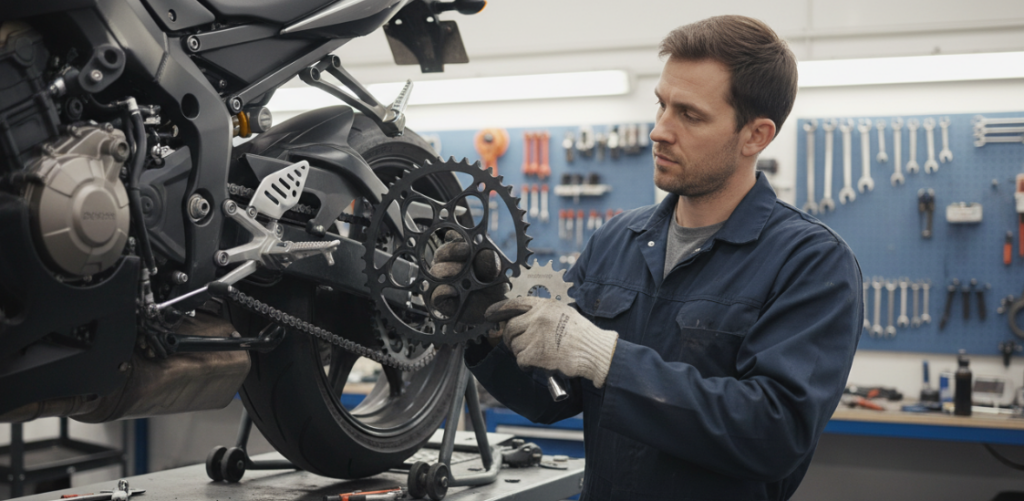
In order not to ride on the “time bomb”, you have to take the initiative to pay attention to the health of the transmission system. Although the requirements for each motorcycle are slightly different, the general industry standard for street motorcycles is to maintain a tightness of 1 to 1.5 inches (25-40mm).
Check the manual: always follow the owner’s manual or the sticker parameters on the rocker arm.
Measure the midpoint: Measure the midpoint between the front and rear sprockets and find the tightest point of the chain for adjustment.
Regularly check: Take a look at the chain after every 800 kilometers or after an intense ride.
Maintaining the correct tension ensures that your throttle response is crisp and smooth. It prevents mechanical failures that could be fatal.
Author Name: Alex Sterling
“Hi, I’m a long-time motorcycle enthusiast and technical rider, I’ve spent years in the garage and on the track seeing firsthand how small maintenance oversights can lead to catastrophic failures. I’ve witnessed everything from punctured engine housings to locked rear wheels—all caused by a simple loose chain.”
The prev: Can You Over Lube A Motorcycle ChainThe next: Are All Motorcycle Chains The Same
Related recommendations
-

What Are Sprockets Used For
76Learn What Sprockets Are Used For, How They Bridge Distances Via Chains, And Their Role In Converting Engine Torque.
View details -
How Tight Should A Motorcycle Chain Be
296How Tight Should A Motorcycle Chain Be? Street Bikes: 1-1.25 Inches. Dirt Bikes: 1.25-1.5 Inches. Get The Correct Specs.
View details -
Are All Motorcycle Chains The Same
33Are Motorcycle Chains All The Same? Learn About Sizes, Seal Types, And How To Choose The Right One For Your Bike.
View details -
How To Change Brake Caliper Motorcycle
87Learn How To Change A Motorcycle Brake Caliper Safely. Our Guide Covers Removal, Bleeding, And Essential Torque Specs.
View details