
 Motomaxsfr


Search Product
Best Sprocket Ratio For Motorcycles
There is no single “best” sprocket ratio, as it depends entirely on your riding goals. Generally, a higher numerical ratio (more rear teeth or fewer front teeth) delivers faster acceleration and torque at the cost of top speed, making it ideal for track or city riding. Conversely, a lower numerical ratio improves top speed and fuel economy for highway cruising. A popular starting point for riders seeking more “punch” is the “-1/+2” rule (dropping 1 tooth on the front and adding 2 to the rear). To find your current ratio, simply divide the number of teeth on the rear sprocket by the front (e.g., 45/15 = 3.0).
This video provides an overview of how different sprocket ratios affect your motorcycle’s performance:
Find Out How To Calculate Your Tooth Ratio
To find the so-called “best” gear ratio according to your specific needs, you must first understand the mathematical logic set by the original factory.
Posterior disc teeth ÷ Anterior disc teeth = Final drive ratio
Take a common example of factory settings:
Front tooth disc: 15 teeth
Posterior tray: 45 teeth
Gear ratio: 45 ÷ 15=3.0
This number 3.0 means that the front tooth plate (that is, the countershaft) must turn 3 turns before the rear wheel turns turn. It is very important to understand this benchmark value, because whether you want to adjust the speed or the acceleration later, all the modification adjustments are based on this number.
High Value Ratio Vs. Low Value Ratio
When looking for the best gear ratio for a motorcycle, you’re really making a trade-off between two opposing forces: torque (acceleration) and extreme speed.
High Numerical Gear Ratio (Gearing Down/Downshift Effect)
If you increase the tooth ratio (from 3.0 to 3.2, for example), we call it “Gearing Down”. To achieve this effect, you can:
- reduce the number of teeth in the anterior disc, or
- Increase the number of teeth on the posterior disc.
The result: This setting delivers more torque to the rear wheels. This is the first choice for riders who want explosive acceleration at the moment of exiting a turn, like to play head-warping (wheelies), or need better throttle response in stop-and-go urban traffic. But I have to remind you that this comes at a price: during high-speed cruising, your engine speed will remain in a higher range, which may lower your extreme speed and fuel consumption will become less beautiful.

Low Value Gear Ratio (Gearing Up/Upshift Effect)
If you lower the gear ratio value (from 3.0 to 2.8, for example), this is “Gearing Up”. The operation method is:
- increase the number of teeth on the anterior disc, or
- Reduce the number of teeth on the posterior dental disc.
The result: this setting is ideal for high-speed cruising. It can reduce the engine speed during cruising, reduce vibration, improve fuel economy, and even theoretically increase the speed of the vehicle (of course, the premise is that your engine must have enough power to drive this heavier gear ratio).
The “-1/2” Rule
In the street car performance modification circle, a standard answer to the best gear ratio is often the “-1/2” scheme. This rule suggests:
- Anterior dental disc minus tooth.
- Posterior dental tray plus 2 teeth.
Why Does This Work?
Because the effect of changing the anterior dental disc on the tooth ratio is far greater than that of changing the dental disc. A common rule of thumb is that a 1-tooth change in the anterior dental disc is approximately equivalent to a 3-tooth change in the posterior dental disc.
By combining a smaller anterior disc and a larger posterior disc (-1/2), you significantly increase the transmission ratio value. This will make the car feel more “energetic” and accelerate more, but it will not make the gear too short to make high speed. For most imitation race and street car (Naked Bike) owners, this is a perfect balance.
Clear Your Riding Goals
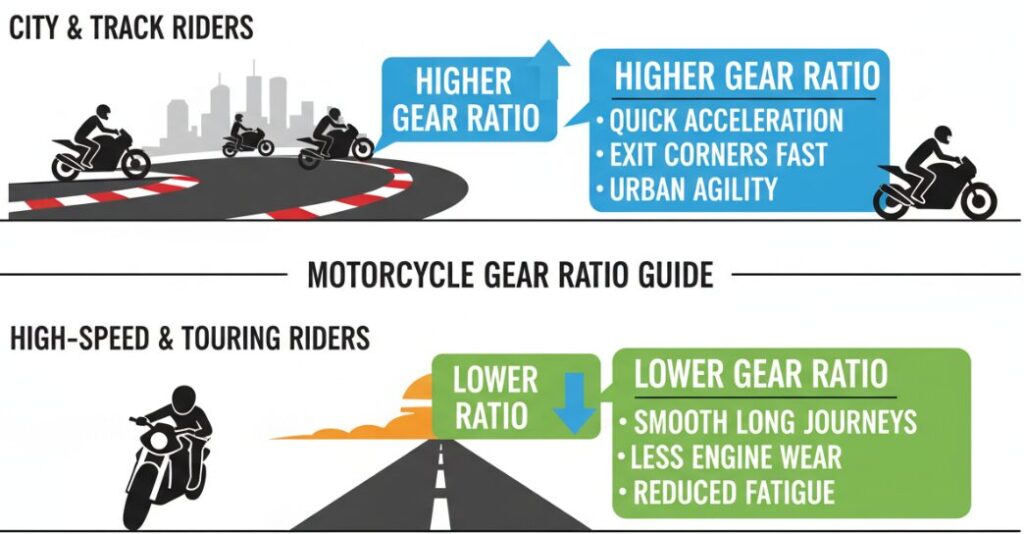
In the final analysis, the best gear ratio for a motorcycle is very subjective and depends entirely on how you use the car.
- For city riders and track players: If your goal is to maximize the driving force when exiting corners, or if you want to have on-call power in urban traffic, run for a higher value ratio.
- For high-speed commuters and motorcyclists: If you’re after a smooth long journey, a lower number is definitely better than that. It allows the engine to maintain a low speed above 70 miles per hour (about 110 kilometers per hour), which not only reduces engine wear, but also reduces rider fatigue.
Author:Pablo
I’m a seasoned motorcycle mechanic and avid rider with over a decade of track and street experience. I specialize in drivetrain optimization, helping riders fine-tune their machines to achieve the perfect balance of torque and top speed.