
 Motomaxsfr


Search Product
How Often Should I Tighten My Motorcycle Chain
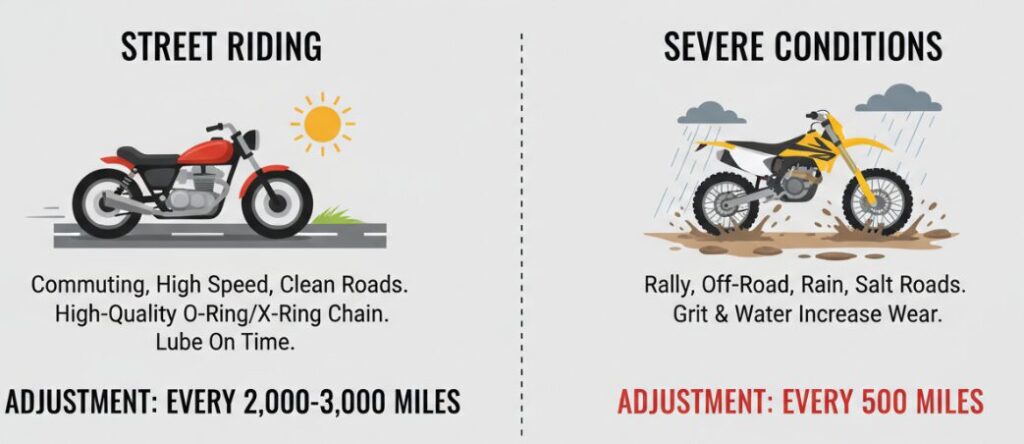
You should check your motorcycle chain tension every 300 to 500 miles (500–800 km), or roughly every 2–3 fuel stops. However, dirt bikes, new chains, or riding in wet and dusty conditions require more frequent inspections. Always refer to your owner’s manual for specific intervals (typically adjusting when you clean and lube). To check, find the tightest point of the chain while on the side stand and measure the slack at the midpoint; if it exceeds your manual’s spec (typically 20–30mm), you must tighten it by loosening the axle nut and adjusting the bolts.
This video explains the importance of checking your chain slack:
Factors Affecting The Lifespan Of A Motorcycle Chain
Although 500 to 800 kilometers is an industry standard, the following variables are the key to determining your adjustment frequency:
Riding environment: If you often run in the rain, or drive on salted roads or dusty dirt roads, those dust particles are like scrub, which will accelerate chain wear. In this case, I would recommend checking every 100 to 200 miles.
The difference between the model: the suspension stroke of the off-road vehicle and the rally car is long, and the chain swing is large, which is easier to loosen than the ordinary street car.
Chain “age”: the new chain has an “initial stretching period” in the first few hundred kilometers, just like the new shoes need to run in. During this period, it grows the fastest, so pay more attention.
Driving style: if you like to start violently or turn your head at every turn, the chain will bear great instantaneous tension and will definitely loosen faster than others.
How Do You Judge The Chain Should Be Tight
You don’t need to carry a ruler in your pocket at all times. Some signals can be felt by your body and ears:
Visible sagging: The chain is obviously drooping, even hanging under the rocker arm for a large which is definitely not possible.
Abnormal noise: Especially when you release the throttle or change gears, if you hear the sound of the chain “snapping” against the rocker arm or chain box, it is reminding you that it is too loose.
Uneven force (dead joints): chain wear is usually uneven. When you turn the rear wheel, if you find that some places are loose and some places are tight and astringent, you have to deal with them quickly, and it may even be time to change the whole set of sprocket chains.
Professional Chain Tension Measurement Method
You can watch this video to learn how to check if your chain is too loose:
In order to be safe, measurement can not be sloppy. These are the safest steps to follow:
Preparation: Park the car on the side bracket (unless your instructions specifically require large braces or frame lifting, which is very important).
Look for the “tightest point”: put in neutral gear and manually turn the rear wheels. The wear of each section of the chain is different. You must make the final measurement at the tightest position of the whole chain. Otherwise, once you adjust the head, it is easy to break the chain or damage the output shaft oil seal when riding.
Midpoint test: in the middle of the front and rear sprockets, push up and then pull down.
Control standard: Measure the total travel of this up and down fluctuation. The standard for most street cars is between 20mm and 30mm. You can look at the stickers on the rocker arm or flip through the instructions.
How To Adjust The Chain
If the measured value exceeds the standard, then follow this process:
Loosen the axle nut: Use a large wrench to loosen the large nut of the rear axle, as long as the rear wheel can be moved, without completely unscrewing it.
Adjusting bolts: The adjusting bolts (or adjusting blocks) on the left and right sides should be rotated synchronously. I am used to turning only 1/4 turn at a time, so it is easy to control.
Alignment scales: Look at the alignment scales on both sides of the rocker arm to make sure the wheels are positive. If the wheel is crooked, it will not only cost the chain, but also affect the cornering control.
Reset and tighten: after reaching the range of 20-30mm, tighten the rear axle nut with a torque wrench. Be sure to check the manual to see the specific number of kilograms of torque.
Final retest: This is the most overlooked step. After tightening the large nut, be sure to measure it again! Many times in the process of locking the axle nut, the chain tension will be fine-tuned.
Author: James Miller
As a lifelong motorcycle enthusiast and DIY mechanic with over 15 years of riding experience, I’ve learned that the secret to a long-lasting bike lies in the details. I specialize in teaching riders how to handle their own maintenance—from chain tensioning to oil changes—ensuring every journey is both safe and smooth.