 Motomaxsfr


Search Product
Motorcycle Chain Measurement And Wear Inspection
The three-digit code on your chain links (e.g., 520, 525, 530) follows a standard “Rule of Eighths.” The first digit is the Pitch (distance between pins) measured in 1/8th inch increments (so a ‘5’ means 5/8 inch or 15.875mm). The last two digits denote the Inner Width (between the inner plates) in 1/80th inch increments. For example, a 520 chain has a 5/8″ pitch and a width of 2.0 (representing 2/8″ or 1/4″ / 6.35mm). A 530 chain has the same pitch but a width of 3.0 (3/8″ / 9.525mm). Below, I’ll teach you how to measure a chain that has no visible numbers, and how to measure for “slack” and “wear” so you don’t end up stranded on the side of the road.
How to Measure Chain Size (When the Numbers are Gone)
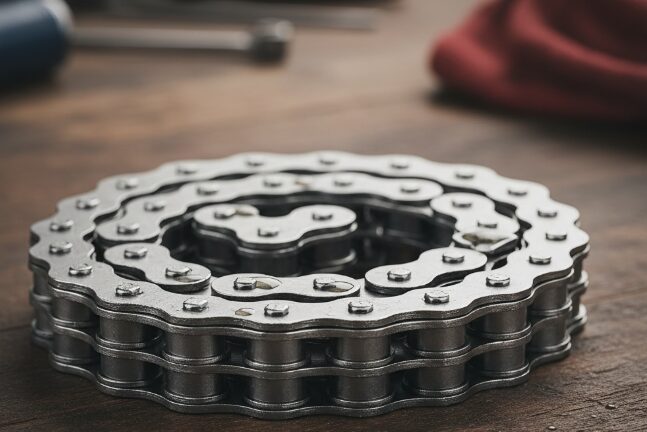
When I work in the store, what I see most is the rusted chain or the chain covered with sludge. The “520” and “525” steel seals on it are not clear at all. What’s more, sometimes the last car owner installed the wrong model at all. To understand this, you need a digital caliper. There are only two places we need to measure: pitch and inner width.
Measure the pitch (determine the first number)
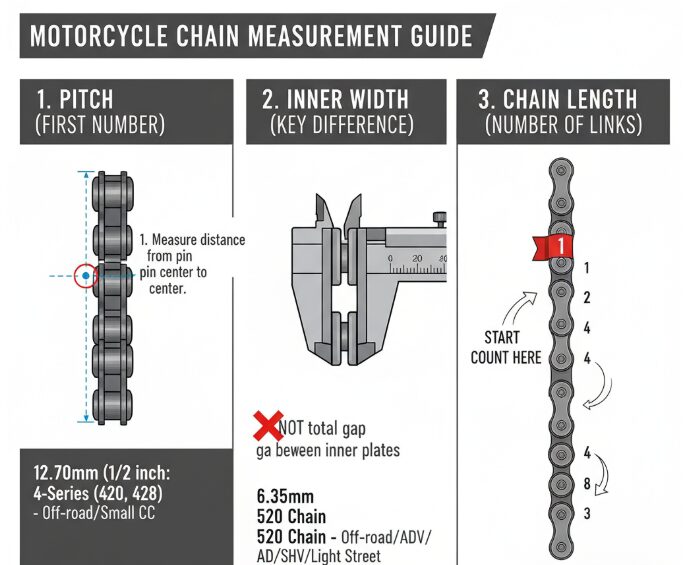
The pitch determines whether the chain can bite perfectly with your dental plate teeth.
Measurement method: measure the distance from the center of one pin to the center of the next pin.
How to see the number:
- 12.70mm (1/2 inch): This is a 4-series chain (such as 420, 428). Generally used in off-road vehicles and small-displacement street cars below 125cc.
- 15.88mm (5/8 inch): This is the 5 series chain (520, 525, 530). To be honest, 90% of street cars, from Ninja 400 to Suzuki Falcon, cannot escape this range.
Measure the inner width (this is the key difference)
Listen, don’t measure the total width of the outside of the chain, that’s bullshit. You have to measure the gap between the inner link plates-this is where the tooth plate tooth fortress enters.
Measurement method: use the caliper’s inner measuring claw to measure the gap between the inner chain plates.
to see how the number (metric units):
- 6.35mm (1/4 ″): What you need is a 520 chain. (This is standard for off-road vehicles, ADVs and light street vehicles).
- 7.94mm (5/16 ″): What you need is a 525 chain. (Now the mainstream 600cc-900cc sports street cars basically use this).
- 9.53mm (3/8 ″): What you need is a 530 chain. (Public upgraded supercars and heavy cruising vehicle dishes).
Number of chain sections (length)
We often say “120 chain”, refers to the 120 pins, rather than 120 pieces of chain plate, novice don’t make a mistake.
Old Master’s trick: Use a paint pen or 1 a small piece of tape to mark the first section of your start count. Then count the pins one by one until you get back to the mark. If you count a singular number (say 113), you must have counted it wrong, and count it 1 times-the chain is always an even number of sections. Unless you’re playing with some special modification that uses a half-link (Half-link), but I rarely recommend that stuff on a street car.
How to Measure Wear & Tension (Safety Checks)
What I said earlier is how to choose the right chain. Now this is the business related to your riding safety. You need to make two kinds of measurements on a regular basis: tightness measurement (routine maintenance) and elongation measurement (life judgment).
Measure the tightness (tension) of the chain
The correct tightness can prevent the chain from being broken when the suspension is compressed. According to my experience, a chain that is too tight is actually more deadly than too loose, because it will directly kill the output shaft bearing of the gearbox, which is expensive to repair.
Preparation: Support the side ladder of the car (pay attention to your user manual, some Ducati or BMW models require the main station or parking frame). Find the midpoint of the chain between the anterior and posterior trays.
Measurement method: Push the chain up to the end with your hand, and measure its position relative to the rear rocker arm with a ruler. Then, pull the chain down to the end and measure it again. The difference between these two positions is the tightness of your chain.
Target range: Most street cars require tightness between 25mm -35mm (1 to 1.4 inches). Off-road vehicles need to be looser (about 35mm -50mm) because of their longer suspension travel.
Measurement of chain elongation
In our jargon, it is called “chain stretched”, but this thing, the metal itself is not so easy to stretch, mainly because the pins and sleeves are worn out, resulting in a larger gap and an increase in the total length of the entire chain. You can’t see it with your eyes alone. You have to use the “20-pitch measurement”.
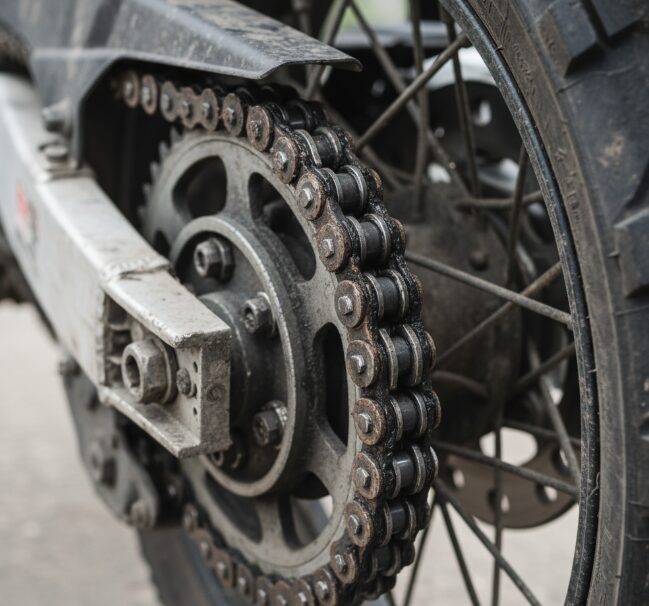
Measurement method: apply a little tension to the chain (turn the rear wheel so that the upper side of the chain is tight). Measure the length across 20 pins (I. e., from the center of pin 1 to the center of pin 21).
Use limit:
- Standard length (brand new 5 series chain): 317.5mm.
- Replacement limit: If the measurement result reaches or exceeds 323mm, don’t hesitate to change it! Once this number is exceeded, according to my experience, the hardened layer of the pin is basically worn out, and the subsequent wear will accelerate sharply. It is only a matter of time before the chain is broken.
The “Pull Test” Shortcut
If you don’t have a ruler on hand, there’s a quick check that the old guns know. Go to the back of the car, find the three o’clock position of the back tray, hold the chain with your hand, and try to pull it straight back from the tray.
- New chain: You will find it motionless and tightly pressed against the dental tray.
- Worn chain: It can pull out about half a tooth gap. This is when you should consider placing an order for a new chain and dental tray.
- Severely worn chain: You can easily pull the chain up and even see the complete teeth. If you come to this point, don’t ride this car, it’s too dangerous. Go find the right model and order a new set of chain teeth.
About the author
Hi, I’m Tom.
With over 16 years of experience turning wrenches in professional motorcycle shops, I’ve seen enough snapped chains and cracked engine cases to know that “guessing” isn’t an option. I wrote this article hoping to help you measure your bike’s specs correctly so you can buy the right parts, save money on labor, and—most importantly—ride home safely. If I wouldn’t do it to my own bike, I won’t tell you to do it to yours.