
 Motomaxsfr


Search Product
When To Replace Motorcycle Chain
You should replace your motorcycle chain when it shows clear signs of wear such as hooked sprocket teeth, kinked links, or excessive slack that can no longer be adjusted. While most O-ring chains last between 15,000 and 30,000 miles, replacement should be based on physical condition rather than mileage alone.
This video briefly explains when to replace chain and sprocket:
Key Signs It’s Time To Replace Your Motorcycle Chain:
The “Pull Test”: Pull the chain away from the rear sprocket at the 3 o’clock position. If you can see more than half a tooth or a large gap, the chain is overstretched.
Hooked Sprockets: Inspect the teeth; if they look like “shark fins” or are bent to one side instead of being symmetrical, they are worn out.
Kinked or Stiff Links: If links remain bent (kinked) after cleaning and lubing, the internal O-rings have failed.
Maximum Adjustment Reached: If the rear axle is at the end of its adjustment slot and the chain is still loose.
Rust and Noise: Excessive grinding noise or heavy orange rust that won’t come off with cleaning.
Pro Tip: For safety and longevity, always replace the chain and both sprockets (front and rear) as a complete kit.
Signal For Changing Motorcycle Chain
I will take the above points apart and talk about them, so that you will know where the key points are next time you do it yourself.
Check The Internal Tension Through Tensile Test
Many people think that the chain stretch is a longer metal, but it is not. The main reason is that the pins and bushings inside the chain are worn out, resulting in a larger gap and a longer pitch of the entire chain.
How to do it: find the position directly behind the back tooth plate, pinch the chain with your hand and pull it out.
Conclusion: The chain in good condition can hardly be pulled. If you can pull open an obvious gap, it means that the pitch of the chain is no longer in line with the tooth plate. At this time, the power transmission will become extremely unstable and the teeth may jump at any time.
“Shark Fin”-shaped Dental Disc Wear
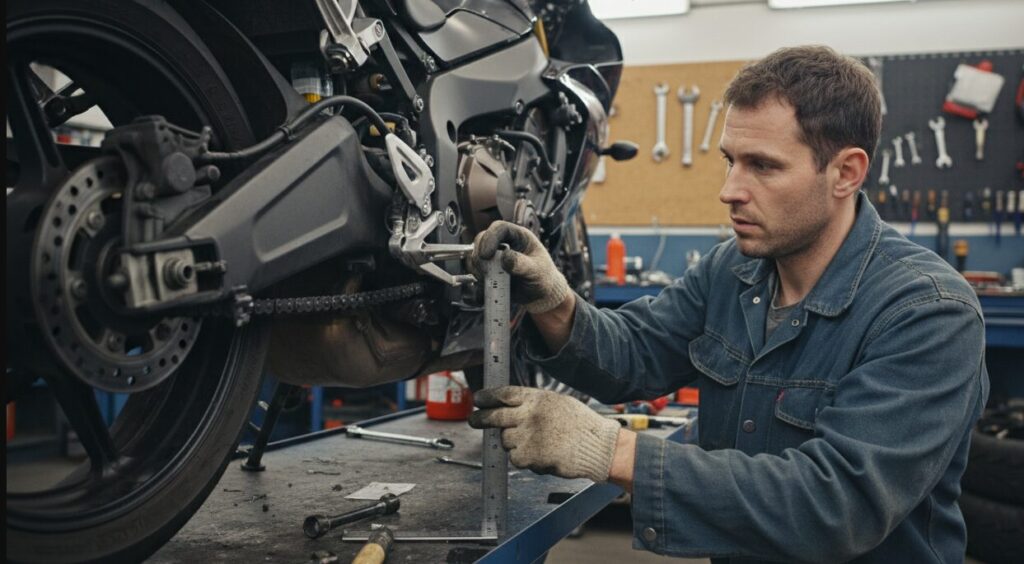
Chain and tooth disc is a symbiotic system, they are “run-in” with each other.
Symmetrical vs. hooked: The tips of the new dental discs are smooth and symmetrical. After severe wear, the teeth will become sharp and bend in the driving direction.
Side wear: If you find that the side of the tooth is worn, it usually means that your rim is not right, or there is a problem with the swing arm shaft. Don’t ignore this “shark fin”, it can’t grasp the chain, easily lead to off-chain.
Kinked Links
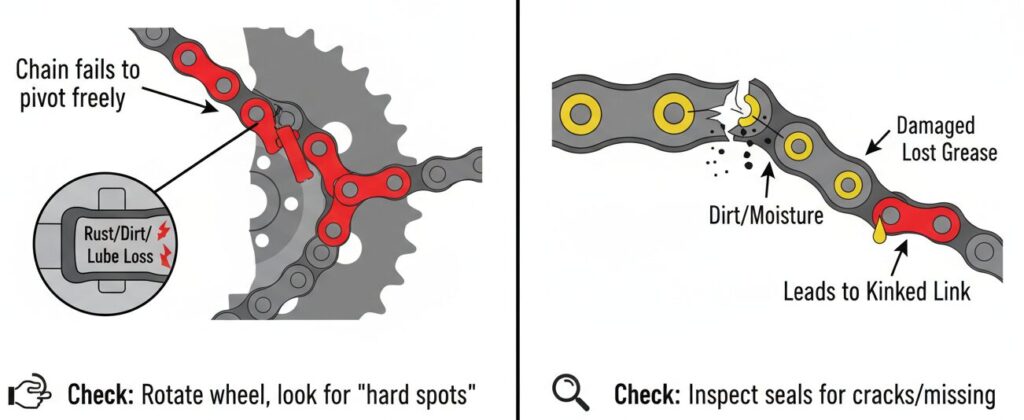
Modern chains rely on O-rings or X-rings to seal the grease inside the rollers. Once the sealing ring is broken, the oil inside comes out, the soil outside goes in, and the inside of the chain starts dry grinding.
Symptoms: If you see that the chain is always not straight in some positions when you turn the rear wheel, like a dead bend, it is a dead joint.
Countermeasures: don’t expect to rely on more spray lubricating oil to save back. This internal damage is irreversible, and the structural strength of the chain has been greatly reduced.
Reaching The Limit Of Regulation
The rear swing arm of each car has an adjustment groove to compensate for the natural stretch of the chain during use.
End: If the rear axle has retreated to the end of the adjustment groove, and the chain sag still exceeds 30-40mm (see the instructions for details), it means that it has “died.
Warning: Never forcibly “shorten” an old chain by removing one or two links. I ‘ve seen people do this, and it’s extremely dangerous, because the chain metal fatigue is already very serious at this time.
Can Not Ignore The Noise And Rust
A healthy chain should run with a rhythmic “buzz.
Abnormal sound of wear: If there is enough oil or the “click” sound of metal impact, usually the roller has broken or worn too much.
Orange oxidation: a layer of floating rust on the surface is fine, just wipe it off. But if it is the kind of deep metal layer, accompanied by pitting thick rust, indicating that the chain has been brittle, at any time there is a risk of collapse.
Replace The Chain And Sprockets As A Set
Regardless of whether your inspection reveals a stretched chain, worn sprockets, or both, you must always replace the front sprocket, rear sprocket, and chain together as a complete set.
The reasoning is simple: The drivetrain is a system of interlocking parts that wear together. A new chain will be quickly ruined by running on old, worn sprockets. Conversely, an old, stretched chain will rapidly wear down new sprockets. Replacing only one part of the system is a false economy that will significantly shorten the life of the new component and lead to poor performance. More importantly, a mismatched set compromises the smooth and reliable transfer of power, creating an unnecessary safety risk.
Author :George
I am a lifelong motorcycle enthusiast and hands-on mechanic with over 18 years of experience maintaining high-performance bikes. My passion lies in helping riders understand the technical nuances of their machines to ensure both peak performance and road safety. Having logged thousands of miles across various terrains, I know firsthand how critical a well-maintained drivetrain is. I’m dedicated to sharing practical, safety-first maintenance tips so you can spend less time in the garage and more time enjoying the ride.