Motomaxsfr


Search Product
When To Change Motorcycle Chain And Sprocket
If you find that there is a problem with the chain and toothed disc, you must quickly replace them as a set. Don’t hesitate. The specific signal is actually very clear. When you see that the cusps of the toothed disc have become “hooked” or shaped like “shark fins”, or the chain has a dead knot (stiff link) that cannot be straightened, or even if you have just finished adjusting it, The chain tension still quickly exceeded the limit of the repair manual, which means that the life is over.
If you hear a crunching break-in sound while riding, or an inexplicable vibration from your pedals, you can also try what I often call “pull test”—— pulling the chain outward from the rear toothed disc at 3 o’clock. If you can pull it apart and expose more than half the depth of the teeth, your drivetrain is dead. A high-quality O- or X-seal chain will usually last 15,000 to 20,000 miles, but if you see rust, or that orange dust (which means the internal metal has started to dry grind), or the adjustment bolts on the swing arm have reached their heads, then this is a serious accident hazard. There is no room for negotiation when replacing a complete set, because the old toothed disc will instantly destroy the new chain, which may eventually lead to chain breakage or even a hole in the engine box.
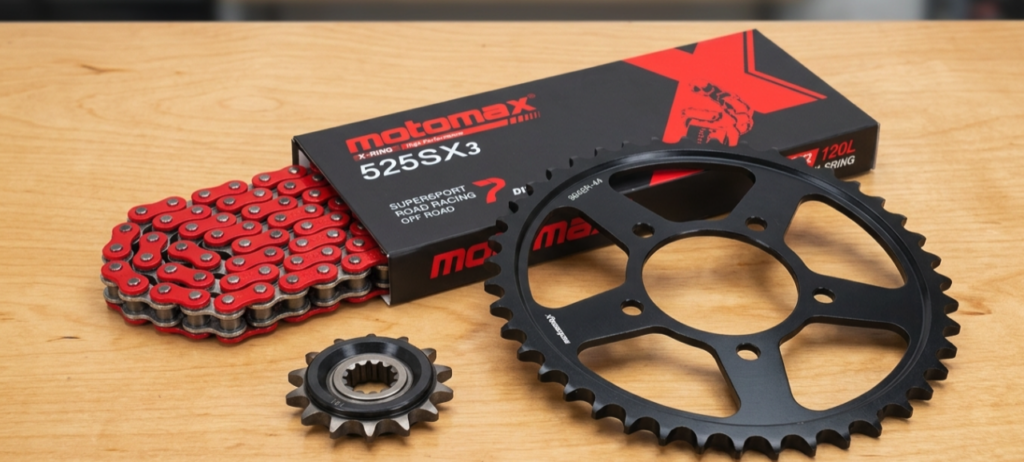
Visual Wear Identification
When I checked the motorcycle, the first thing I saw was the cusp profile of the toothed disc. The cusps of the neodentate disc are very symmetrical and flat-topped. However, as the metal is constantly worn away, the tooth cusps begin to tilt in one direction, forming what is known as a “hook” or “shark fin” shape.
This is because the chain rollers exert a huge pulling force on the tooth tips under load. Once these cusps become sharp or curved, they won’t engage perfectly with the chain. This causes the chain to develop “creeping teeth” when subjected to force, not only will the power transmission be compromised, but in extreme cases the chain will even fall off directly.
Diagnosing Chain Health
Chains tend to break apart from the inside. As I just mentioned, those dead knots that bend and can’t be straightened are irrefutable evidence that the chain is failing. This usually means that the grease in the seal has dried or become contaminated and the pins inside have begun to harden.
One “red light signal” is the orange dust that appears on the chain. This is not just any surface rust, but rather oxidation of metal shavings from the intense wear of the internal pins and bushings. Just by looking at this, the structural strength of this chain is completely played out and must be replaced immediately.
Core Measurement
Besides looking, you also have to use some simple mechanical measurement methods. This “pull test” is what I think is the most reliable old mechanic’s trick:
Try pulling the chain straight back firmly at the 3 o’clock position on the rear toothed disc. If you can see more than half the tooth tip depth from behind the chain, it means that the pins and rollers of the chain have been badly worn and the entire chain “pitch” has been stretched beyond the safe range.
Also, if you find yourself just adjusting the chain tension and it loosens up again after a ride out, it means the chain has reached its elastic limit. If the adjusting bolt has been adjusted to the head and there is no room to tighten it any further, then the chain is “dead” in the legal sense.
Sensory Warning
In fact, the motorcycle itself will also tell you when it is time to spend money through its sound and feel. A drivetrain in good condition should be very quiet to ride. If you hear a rhythmic grinding or “clicking” sound while driving at low speeds, it’s mostly the chain links struggling to chew through those worn tooth grooves.
Similarly, if you feel the vibration on your foot pedal increase as the vehicle speed increases, it is usually because the chain has developed “tight spots”, that is, uneven stretching. This unbalanced pulling force puts enormous pressure on the countershaft bearing. If the bearing is damaged, the labor cost of repairing it will be ridiculously high.
Unnegotiated Rules
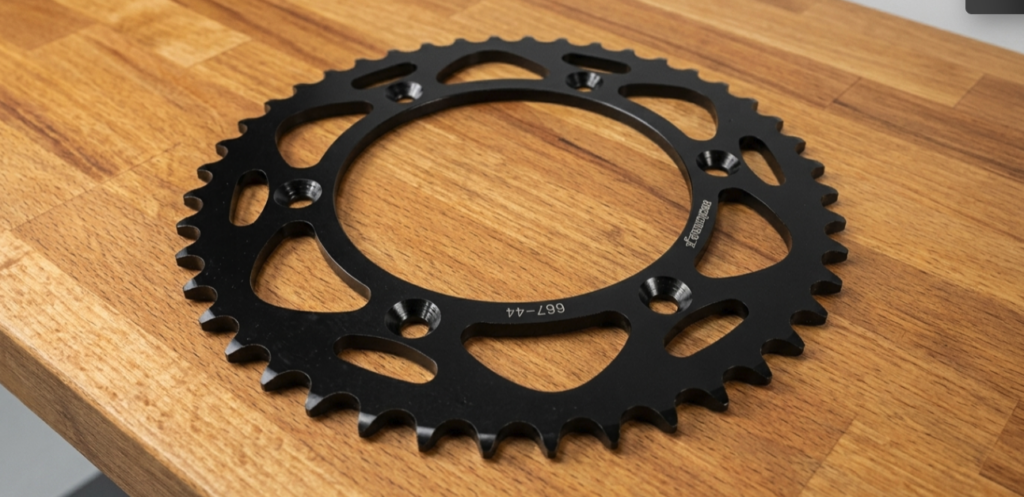
The wear lines of the old toothed disc and the pitch of the new chain simply don’t match. If you hang a new chain on an old toothed disc, the old tooth tip will, in just a few hundred miles, forcefully stretch the new chain to fit its shape. This will directly shorten the life of your expensive seal chain by 70%. So, replacing a set is not only for safety, but also the most cost-effective approach in the long run.
Summary
Riding a scrapped drivetrain on the road is extremely dangerous. A high-speed chain break could lock the rear wheels directly or knock the engine into a hole. Pay more attention to whether the gear plate becomes sharp, occasionally do a tension test, and replace it honestly when the mileage is reached. This will ensure that you ride smoothly and the engine can live for a few more years.
Author: Mike Miller
My mission is to share the “grease-under-the-fingernails” experience I’ve gained on the shop floor to help riders stay safe, save money on repairs, and keep their drivetrains running smoothly. When I’m not wrenching, you’ll find me out on the open road, testing the very parts I write about.
The prev: How Long Do Motorcycle Sprockets LastThe next: Are Motorcycle Sprockets Universal
Related recommendations
-

Can You Over Lube A Motorcycle Chain
88Avoid “Fling-Off” And Wear. Learn Why Less Is More When Lubricating Your Motorcycle Chain For Better Safety.
View details -
What Happens If Chain Breaks On Motorcycle
104A Veteran Mechanic Explains The Dangers Of A Broken Chain: Engine Failure, Wheel Lock-Up, And Vital Safety Tips.
View details -
How To Clean Motorcycle Brake Calipers
114Learn How To Clean Motorcycle Brake Calipers Yourself. Follow Our Expert Guide To Ensure Safety, Prevent Drag, And Save.
View details -
520 vs 525 vs 530 Chain Dimensions & Specifications
949“520, 525, 530” are the three most common specifications for Motorcycle Chain Dimensions. They are not just numerical distinctions, but a complete system of 3 core parameters Diameter Pitch, Inner Width, and Roller. By understanding the meanin...
View details